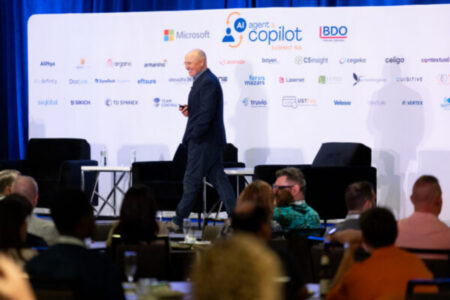



A Microsoft executive speaking at AI Agent and Copilot Summit delivered significant insight on how the forthcoming Copilot Cowork, WorkIQ, and Agent 365 add fuel to a shift, often predicted by the company, away from traditional SaaS software to AI agents.
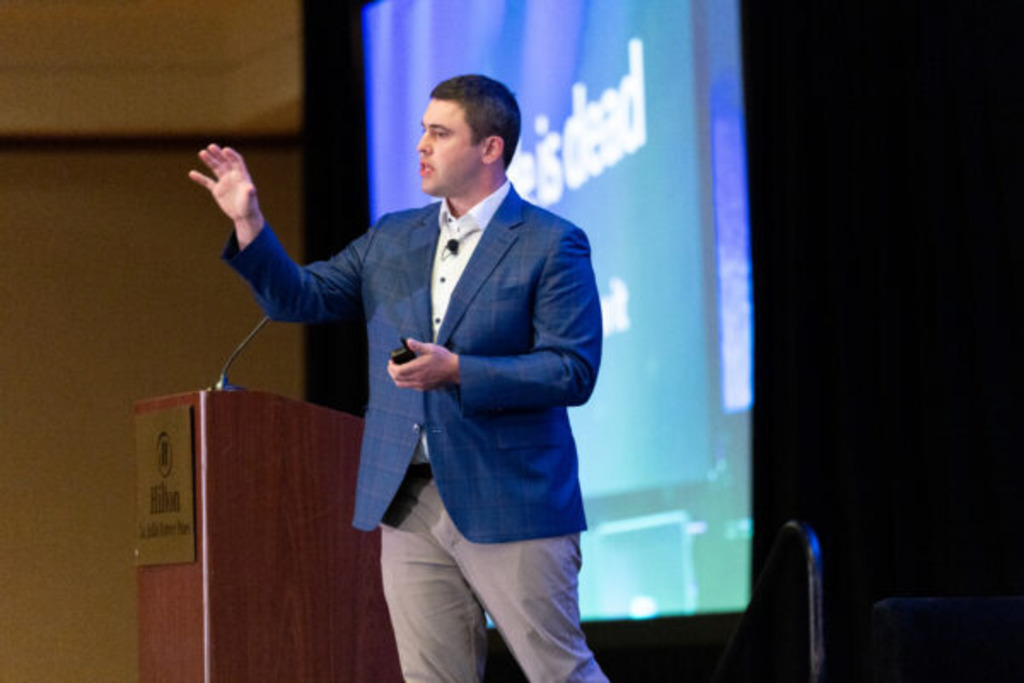
Key takeaways from James Oleinik, Partner Director of Product Management at Microsoft, from his Tuesday keynote in San Diego (pictured above):
- The era of application-centric workflows is ending as companies move to an “agent-centric system of work”
- That change is so dramatic that 20% of every team will be comprised of agents in the near future
- The two shifts above raise the likelihood that the “only app people ever have to open is Copilot if they want to”
The predictions — largely in line with Microsoft CEO Satya Nadella’s late 2024 statement that agents would eventually replace apps — reinforce the company’s emphasis on copilots as the interface to applications and data, while agents perform an ever-increasing amount of work, including engagement with systems and data.
Agents are becoming the operators of back-end processes and tasks, and this is not an incremental change, Oleinik said. “The shift from app-centric workflows to agent-centric workflows is on the same level as the shift from mainframes to PCs.”
At Work: Copilot Cowork
Oleinik’s conclusions drew upon more-detailed demos of Copilot Cowork, WorkIQ, and the Agent 365 control plane than the company has provided in recent events when it first detailed each of those products.
A fresh preview of Copilot Cowork (following last week’s announcement of the platform, which is based on Anthropic Claude Cowork) highlighted the software’s ability to tap into the WorkIQ “intelligence layer” to gain full context from various applications — without the need for connectors.
The software handled a request to build a briefing plan for an upcoming meeting, breaking the details of the request into tasks and carrying out the work from start to finish. Cowork created a briefing doc with an account snapshot including all relevant data points, formatted in a company template, with details on opportunities and competitive edges with the prospective customer.
While Cowork moved all the tasks forward at once, humans are able to interrupt and steer the work as it’s carried out, with the company’s security and compliance features built in.
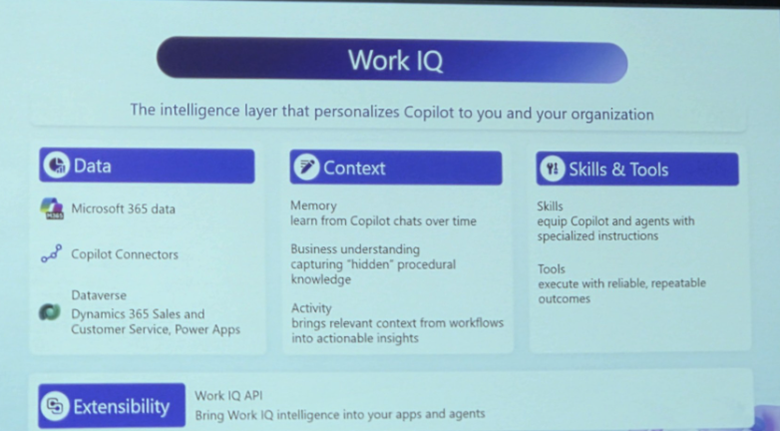
Enabling Copilot Cowork’s intelligence is WorkIQ, which uses data housed in a wide range of Microsoft apps, gathering that data and enabling it for AI. That includes productivity data in Microsoft365 as well as line-of-business data stored in Dynamics, Fabric and Power Platform. Copilot Cowork not only accesses the data but also has an understanding about the company using it and how its teams operate.
The WorkIQ-fueled process making Copilot Cowork operate is in stark contrast to the way productivity apps have worked for 30 years or more, Oleinik said, while agents orchestrating the process have the ability to scale to enormous volumes and capacity – and they never sleep. Copilot will be the primary tool that employees use to interface with AI and delegate tasks to agents, he said.
The functionality and rapidly expanding agent usage – Microsoft has regularly cited data that there will be more than a billion agents in use in two years – led to the conclusion that 20% of every team will be comprised of agents in the near future.
Oleinik acknowledged the career angst that employees experience as these changes play out; I’ll provide more insights from AI Agent and Copilot Summit speakers on that topic specifically in a followup analysis.
Agent 365, also previously detailed by Microsoft, will provide guardrails and managerial functions through a single pane of glass to manage the full ecosystem of Microsoft and third-party AI agents under the agentic system of work concept. Agent 365 incorporates functionality of Microsoft’s Entra, Purview, and Defender tools.
AI-Powered Coding
In other topics Oleinik addressed, he cited the power of AI coding agents, in particular Anthropic’s Claude Code, and he shared a view that AI is accelerating the death of low-code tools. He noted that when he started using Claude Code, he quickly migrated “from writing code to directing AI to write the code and building the features I wanted. It was addictive.”
“For the first time in my life, I was constrained only by the amount of hours I could direct to AI to make what I wanted a reality,” he said, adding that many in attendance also have likely experienced the revelation of “I’m delegating to AI; it’s no longer assisting me, it’s working on my behalf.”
Oleinik’s statements about Claude are one additional data point indicating the value Microsoft is placing on Claude technology — Copilot Cowork incorporates Claude Cowork technology and Claude is also used in new SharePoint AI feaetures. Taken together, the developments highlight the increasingly strong relationship between Microsoft and Anthropic. Microsoft’s support for Claude models has been a strong indicator of its commitment to AI model choice and flexibility.
Related Microsoft and AI Insights:
- Microsoft Agent Framework Enables Complex, Multi-Agent Actions
- Copilot’s Advantage vs. Stand-Alone Chatbots
- Becoming Frontier at Microsoft AI Tour NYC: Inside the Agent-First Enterprise
Ask Cloud Wars AI Agent about this analysis