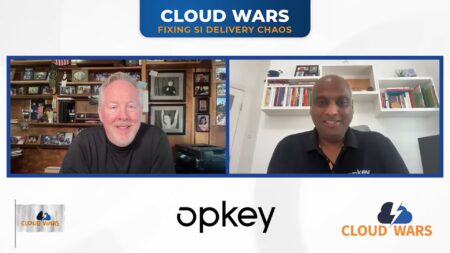



In one of a series of interviews held at this year’s Oracle AI World conference in Las Vegas, Nevada, Cloud Wars founder Bob Evans met with Hasan Rizvi, Executive Vice President of Database Engineering at Oracle. Evans and Rizvi discussed Oracle’s multicloud strategy, the latest Oracle AI Database innovations, data security, and the importance of simplifying data management.
Evans began by asking Rizvi to explain what Oracle’s ground-breaking multicloud strategy has meant for its customers. “If you look back at Oracle’s history, we’ve always been about giving customers choice,” said Rizvi. “We run on-premises. We run on Cloud@Customer. We can bring the cloud to your data center, and we run of course, on public cloud.”
Oracle recognized that as customers were making qualified choices about their public clouds, they wanted their database to run close to the applications they ran in those clouds. “While OCI obviously is a very strong offering and we keep enhancing it, we want to give customers choice,” said Rizvi.
“Just in the last 12 months, we’ve doubled our multicloud regions from 35 to 71, including 22 new regions for AWS. We also launched nine new AI Database services across Google Cloud, AWS, and Azure. Our customers are really finding it very useful.”
Moving on to the demands of the AI Era, Evans asked Rizvi how Oracle AI Database gives customers a competitive advantage as AI projects move from pilot to production. Rizvi used the analogy of a customer asking a question to a generic AI assistant and receiving a generic answer. “If you ask an agent that knows your business, you’re going to get a much better answer,” he said.
“The AI that knows most about the world is not going to be the one that works best.” Instead, it’s AI that knows your data. Your data is what turns general intelligence into an intelligent business, and that, said Rizvi, is the advantage of Oracle AI Database.
“We’re investing in Oracle AI Database to help customers bring AI to their data. We’re building in capabilities like vectors and semantic search, Graph RAG, to understand how relevant information is connected and Select AI Document Intelligence that enables AI to search your most complex documents. So, customers can use Oracle AI Database with unstructured data and find information by meaning.”
Security More Critical Than Ever
Referring to Oracle co-CEO Clay Magouyrk‘s keynote earlier that day, in which he paired business context with security, Evans asked Rizvi for his take on how cybersecurity has changed since the widespread adoption of AI.
“I think AI is really changing the security imperatives very quickly,” responded Rizvi. “It used to take fairly sophisticated actors lots of time and resources to carry out attacks. Now, attacks can be launched much more easily and quickly.”
“We’ve always looked at how we can help customers remove data fragmentation,” continued Rizvi. “Our strategy has been to build a converged database engine that can support multiple data types and multiple workloads.” He explained that while this was once a cost and complexity argument, today it has become a security argument.
“It needs to be part of the security posture because the speed at which you have to patch; you can’t secure a fragmented data stack at AI speed,” he said. For users who don’t want the responsibility of responding to vulnerabilities, Oracle Autonomous AI Database provides a fully managed option, explained Rizvi.
“We patch it. We make it secure. We encrypt everything,” he said.
And, why choose a converged alternative over the point solution databases being touted by other vendors, asked Evans “We’ve been investing in the database engine for 40 years. We have all the mission-critical capabilities you need for your critical data: availability, scalability, reliability, and security.”
“That’s an investment that we’ve been doing for many, many years.”
From a customer perspective, Rizvi explained, a converged database eliminates the need to implement the same core capabilities — availability, scalability, reliability, and security — across different platforms. Essentially, removing some of these steps and relying on a converged solution helps bring order to increasingly complex and chaotic IT environments.