

As part of Community Summit NA, RSM and Community Summit brought together business, finance, and technology leaders for an exclusive VIP Frontier Customer Day focused on navigating the next era of Microsoft technology and AI.
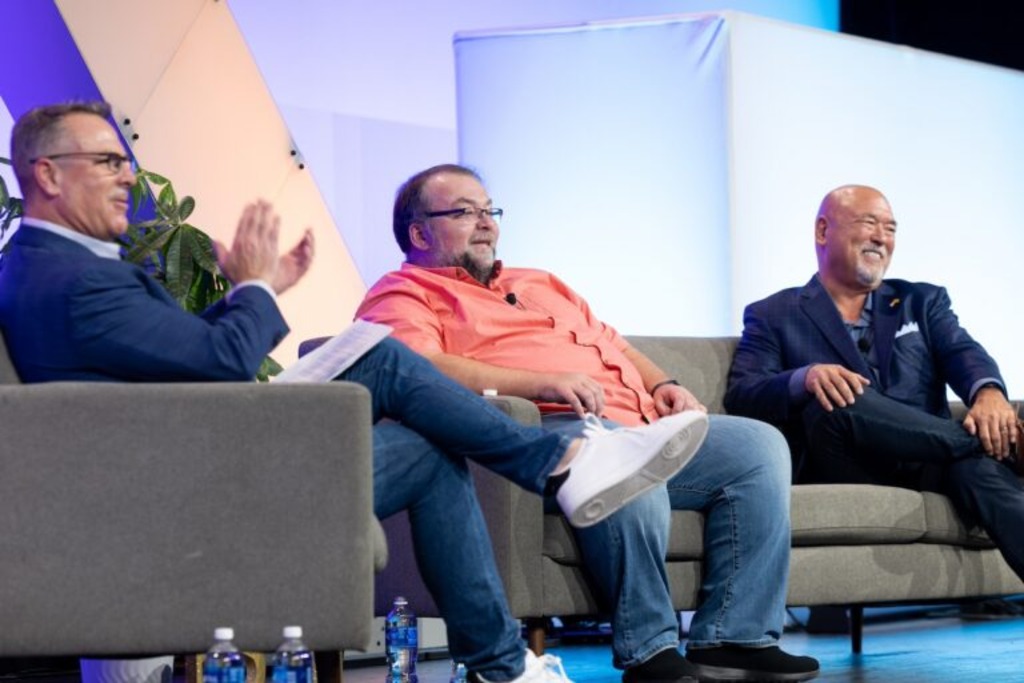
To kick off the event, Mike Gillis, Owner/Principal at RSM, and John Siefert, CEO of Dynamic Communities and Cloud Wars, were joined by Microsoft legend Hal Howard, who, while at Microsoft, led the development of the Dynamics products that helped lay the foundations for Dynamics 365 (D365). It’s no exaggeration to call him the godfather of D365.
A Legend’s Perspective
Recognizing his contributions to the D365 community, the session was aptly titled Legend’s Perspective. The conversation began with the evolution of technology and innovation.
“When I started in the 1980s and 1990s, everything was being built from scratch,” said Howard. “At Microsoft, we built a solid foundation. That foundation has since enabled innovation on top of it.”
Over time, more modules have been built into systems, and now AI is being layered on top as a rapid development tool. Howard explained that technology will only continue to improve and evolve. Ultimately, his message was that innovation builds on strong foundations, with AI representing the next layer in the evolution of technology and software development.
The Evolution of Business Processes
Moving the discussion forward, Gillis discussed the changing nature of business processes and strategies.
Historically, businesses were organized into separate departments, each with its own processes. “In this new era, those departmental boundaries are giving way to end-to-end processes that work across multiple departments,” he explained. This creates a real advantage for businesses.
Howard not only worked at Microsoft but continued innovating and building with AI before LLMs became mainstream. He explained how his team developed software capable of predicting whether a deal was likely to close.
“We wanted to predict outcomes,” he said, “so we created technology that could do exactly that.”
Essentially, the message was that you can’t wait for technology to catch up with you. You have to push it towards what you want it to become.
Building Long-Term Customer Relationships
Howard also shared his approach to building long-term customer relationships. Start by talking to customers about the problems they are experiencing, then find the right tool to solve them, he said. When the next problem arises, help them solve that one, too.
“This is how you build a lifelong relationship with a customer.”
Howard’s point was to focus on solving a customer’s problems rather than simply selling a particular technology.
Why Timing Matters in Technology
Siefert asked Howard directly: “What technology did you think would be the next big thing, but didn’t take off as expected?”
Howard said a technology’s success often comes down to timing. Many technologies struggled because there wasn’t enough computing power available at the time. This is one reason AI is possible at scale today: computing capabilities have advanced significantly.
“Looking back at AI-based programming languages, I thought many would become useful much sooner,” he said. However, computers at the time weren’t capable of running them effectively. Many of those ideas and technologies are now being used.
Offering his thoughts on the question, Gillis referenced James Martin’s book Application Development Without Programmers, which explored the idea that there would eventually be so many computers that there wouldn’t be enough people to program them all.
Although the reality may not have unfolded exactly as originally predicted, the outcome is similar: new tools and approaches are changing how software is developed.
Final Thought
Howard, Siefert, and Gillis came to a clear conclusion: while technology will continue to evolve, success comes from knowing how to use it to solve real business problems. As AI continues to redesign software development and business processes at a rapid pace, organizations must be willing to push boundaries, embrace innovation, and stay focused on delivering value to their customers. RSM’s role is to support them every step of the way.