


With explosive customer demand triggering Q2 growth of 93%, rugged individualist Palantir is simultaneously accelerating its attacks on AI labs and models while promising to help customers build safe and sovereign havens for their data as unique foundations for their AI transformations.
Palantir’s stunning Q2 results — and I’ll get to the details in a moment — are incredibly important for a couple of reasons:
- In spite of Palantir’s relatively small size, the 23-year-old company’s radical new approach to how software and AI are architected, deployed, and evaluated by customers are causing and will continue to cause huge changes and innovations across the enterprise-software community.
- The explosive growth trajectory Palantir has been on for the past couple of years is (a) inspiring customers to view all of their strategic investments in software in new ways and (b) forcing other software vendors to rapidly rethink how the AI Revolution is forever disrupting not only their customers but also the very companies whose products and technologies are causing that global upheaval.
Does that sound overblown? A bit much? Evans is over-reacting again?
Those questions are understandable. But let me try to make my case in three steps: first, a powerfully candid and courageous comment from Palantir CEO Alex Karp on the Q2 earnings call; second, some highlights from Palantir’s gravity-defying Q2; and third, with some compelling artguments offered by Karp and CTO Shyam Sankar on the Q2 call.
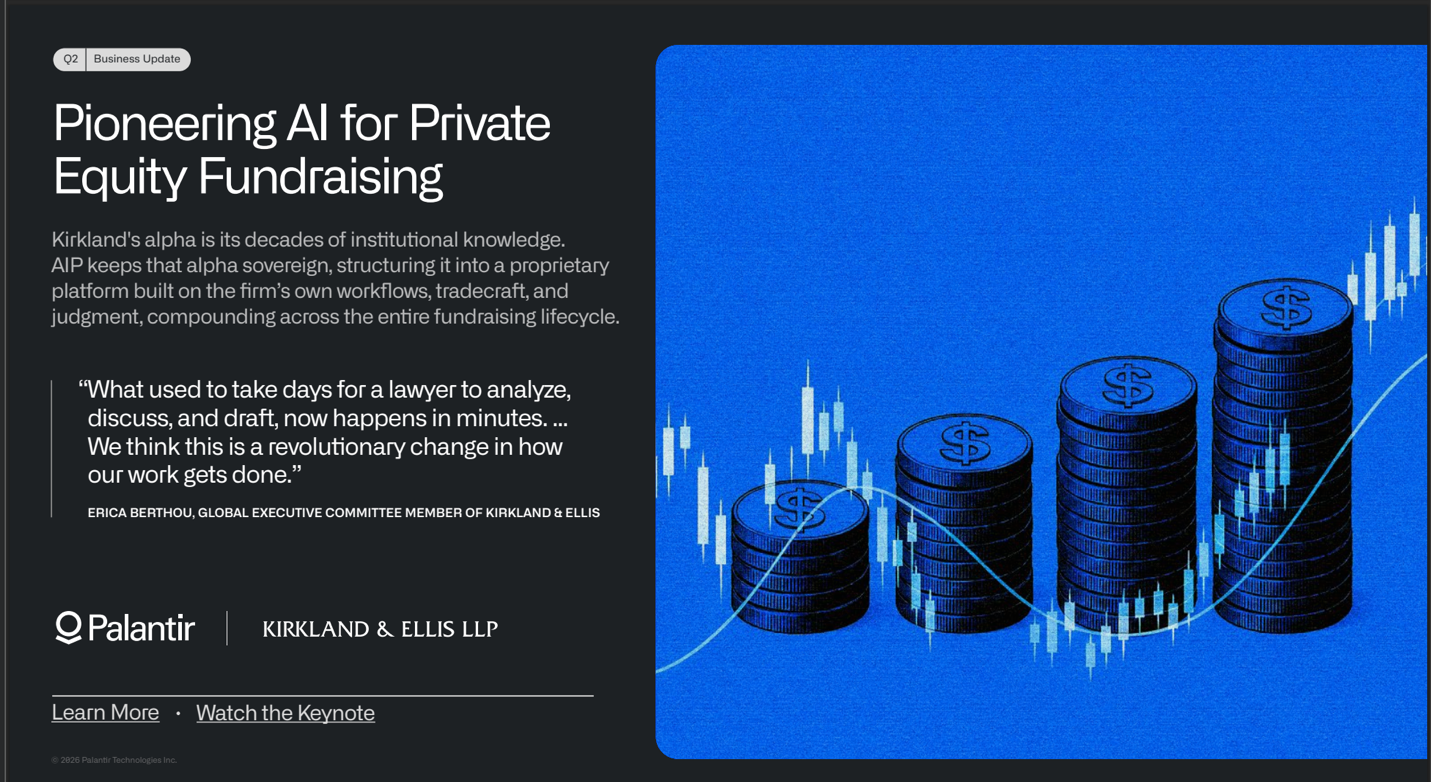
In the slide below, Palantir customer Kirkland & Ellis LLP offers a powerful endorsement of the impact Palantir technology has had on its business.
1. CEO Karp bludgeons status quo, advocates for customer supremacy
While Karp has long decried traditional software-industry sales practices and lampooned the “free steak dinners” mindset, on this week’s Q2 earnings call he definitely cranked up his criticisms to 11. But it’s one thing to complain about how things are, and it’s quite another to chart a bold, clear, and credible way forward. In his opening remarks on the call, he did both — and please note that like the war-fighters he so openly and eagerly champions, he asks no quarter and he certainly gives none.
As you read Karp’s vision for what a software company should be and how it should engage with customers and what it should deliver to them, ask yourself if he’s the sort of guy you’d want to have in your foxhole. (I’ve added some boldface format to highlight passages I feel are particularly important.)
“We rejected the way in which we were being taught in Silicon Valley to build a software company at the time,” Karp said on the call in tracing his company’s long-standing iconoclastic nature.
“Palantir, of course, is now both infrastructure, software, FDEs, orchestration, and business know-how. It’s a completely different hybrid.
“At the time, we were being told our job was to trick the clients into giving us money for something that made them attached to us, but really added no value. Essentially a parasitic model. In the rejection of that, we fully aligned with our partners.
“Now, to do that, as we went through the years, we built PG, Foundry, Gaia, Maven, Ontology, AIP. Now we’re taking the AIP stack and extending it for sovereign AI, which requires us to be able to orchestrate and fine-tune models to provide a completely sovereign stack to our partners. What is the philosophical importance of that?” asked Karp in pinpointing an issue rapidly gaining intense urgency and scrutiny across the industry.
And that’s where Karp really dug in.
“We are offering a present that augurs to a future that we want to live in. And what does that future look like? We have more rights in the PG frame. It’s safer in the sovereign AI frame, which is arguably by far the most important because all these other things are downstream from GDP growth and GDP health.
“What if we transform America into the only democracy that actually grows where production is more efficient and manufacturing actually happens? What is that frame?
“That frame is not you are going to buy into a future where you have no job, where adversaries win, and everybody who does win is a small, tiny group of people living in a tiny place that somehow believes because they eat vegetables and they don’t support war fighters, that they deserve to have the total means of production of this country. And the rest of us should just sit back and absorb the cost of that revolution, which we’re paying for.”
Okay — when was the last time you head a tech-industry CEO deliver that kind of message? And Karp —”because they eat vegetables and don’t support war-fighters” — was only getting warmed up as he unloaded on the new enterprise phenomenon that he dubbed “token self-pleasuring.”
“How are we paying for it? In the enterprise context, people sign up for token self-pleasurings, and at a real cost like other forms of self-pleasuring — where you are paying for the right for them to migrate your IP, your know-how, your expertise to their model so that they can build a competitive business that doesn’t require your business, your people.
“Why are they doing it? It’s actually being done for what they believe are moral reasons. They are superior to you. They deserve to colonize your enterprise. You deserve to be colonized.”
While every tech vendor religiously repeats the mantra that “your data is YOUR data and we’ll never use it in any way,” Karp and Palantir are building out a new software architecture that actually puts that pledge of sovereignty into actual practice.
And while some people for various reasons might choose to dismiss Karp’s argument, it is impossible — utterly, completely impossible — to dismiss Palantir’s truly awesome financial results.
2. Q2 financial highlights
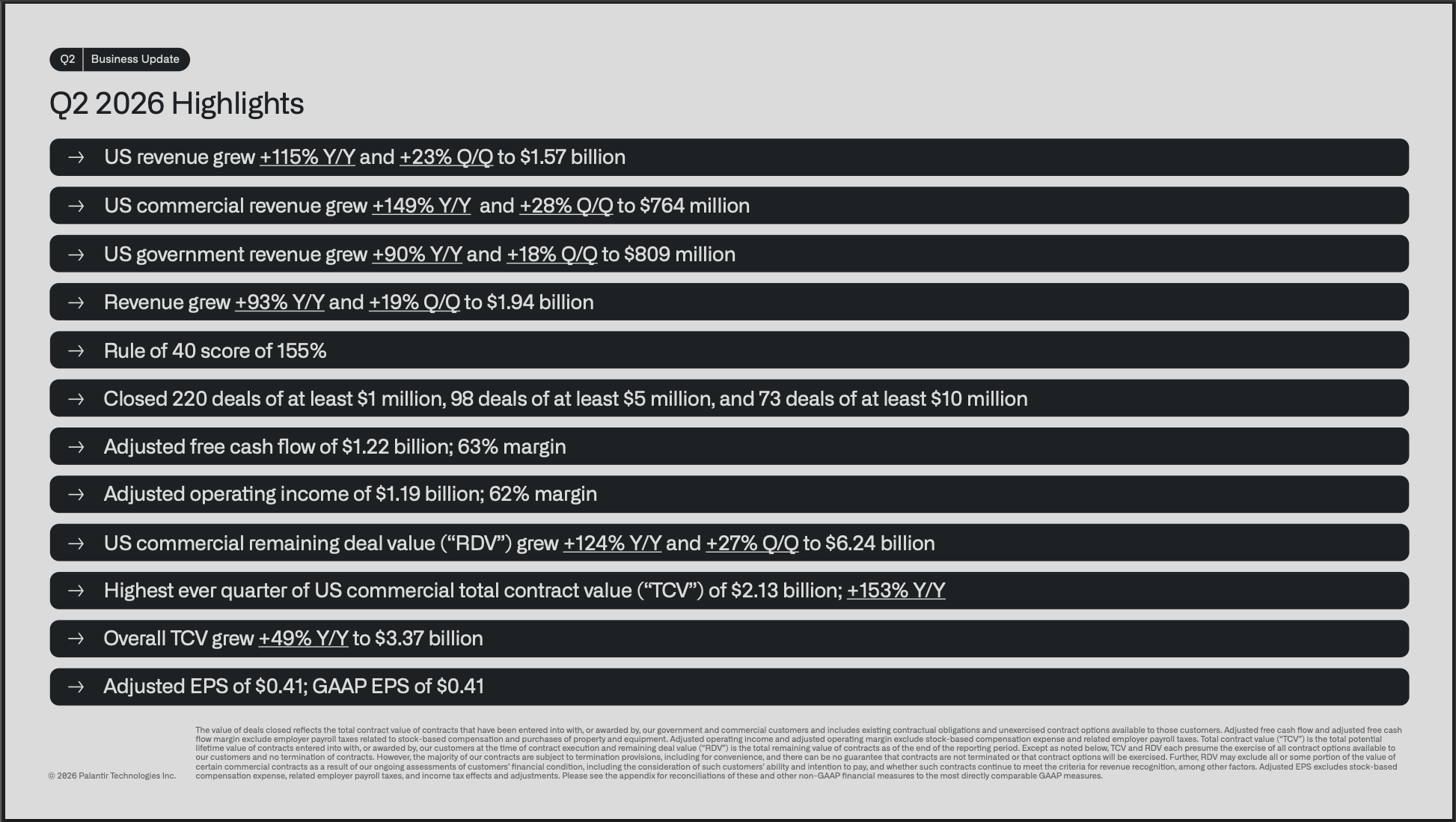
To help put Palantir’s customer-demand momentum into perspective, here are its growth rates for the past three quarters: Q4 of 2025, 71%; Q1 of this year, 85%, and Q2, 93%. And while Palantir’s U.S. government business continues to be its largest and grew 90% in Q2 to $809 million, the superstar is Palantir’s U.S. Commercial business, which soared 149% to $764 million.
And while the numbers tell their own story, Palantir chief revenue officer and chief legal officer Ryan Taylor (I love that combination of responsibilities!) offered a distinctive and powerful contrast between how Palantir regards customer data and how the AI-model companies regard it.
“These results are a clear indication of the profound value we’ve unlocked both for and with our customers who dared to cross the chasm with us,” Taylor said to open the Q2 earnings call.
“In contrast, enterprises that are not using Palantir are seeing their token meters spinning endlessly just to get slop without any correlation to value. This token model may be working for the labs, but it is not working for anyone else. It’s breaking corporate budgets without results to justify the expense.
“Worse,” Taylor continued, “companies are paying to give away their most important secrets, the very basis for their competitive advantage, ultimately contributing to the commoditization of their own businesses as their secrets become the training data embedded in the foundations of all future models.
“On our side of the chasm, what enterprises demand is AI sovereignty, owning the operational definition of the data, logic, actions, and security of their enterprise,” Taylor said.
“An organization’s data is its treasure. In its richness is the alpha. We are fully aligned with our customers, building a stack that enables the compounding of their alpha.”
You can see a full list of Palantir Q2 highlights in the chart below from its Q2 presentation.
3. What Palantir is doing differently
(a) Turning “benchmarks” upside-down
Lab-based benchmarks are disconnected from the real world. Palantir CTO Shyam Sankar made the case that the frenzy over AI-lab benchmarks tells us a lot about the AI models, those benchmarks tell us little or nothing about how well or how poorly AI is performing against our business objectives.
As you read Sankar’s comment from the earnings call, bear in mind that his core argument is one Palantir has used repeatedly: that the norms and traditions of the software industry are often focused on hermetically sealed software performances rather than on business outcomes. And he’s making the case that current practices and technologies are benefitting the model makers more than customers.
“Last quarter, I said tokens are the new coal and AIP is the train. Now, our customers can build their own locomotives,” Sankar said.
“AIP is where your sovereign AI is built, deployed, and compounded. We’re excited for a new era: not one of benchmaxing, but of benchmaking. The assumption that the frontier is actually the best-performing is just not borne out in practice.
“Within 24 hours of bringing Nemotron Ultra into our stacks, we found five production tasks where a standard Nemotron Ultra model without post-training beat frontier models. This underscores that a handful of common benchmarks can be gamed. That era, benchmaxing, has ended. The new era is benchmaking,” Sankar said, with a completely new focus on business outcomes rather than isolated software calisthenics.
“A customer-specific benchmark is not just a scorecard: it’s a hill to climb. It’s the normative orientation that directs your entire operational workflows and post-training pipeline. It defines what ‘better’ means on your terms for your business with your strategy, everything optimizes against it continuously. Because the benchmark is yours, the trade-offs become yours, too.
“AIP gives you the control plane to trade cost, performance, and latency against each other, and to decide where you run your weights versus theirs, workflow by workflow, continuously. You can have a continuous improvement cycle that compounds your alpha into your weights. AIP was built for this. We continue to see that our product is winning head-to-head. The others are focused on productivity. We are laser-focused on turning tokens into real economic value for our customers. The reality is that the market has created far more intelligence than it has converted into value.”
(b) Championing the worker, not the model
Sankar told a remarkable story about a high-impact AI application created by “a proud blue-collar worker who still turns wrenches for a living.”
“We created our American Tech Fellowship program because the most transformative applications of AI that we saw were being driven by people without traditional tech backgrounds on literal front lines and factory floors,” Sankar said.
“We now have over 1,000 ATF grads. One of our speakers, Jonah, who joined Tabet as a submarine-parts manufacturer 13 years ago on the factory floor. He’s a proud blue-collar worker who still turns wrenches for a living. He built an AI application that took production planning from 30 to 40 days down to less than one. AI alone cannot do that.
“It takes AI in the hands of the American worker, the tribal knowledge earned through success and failure on the line, the insights only they have.
“The models are commodities — the American worker is not.”
(c) Transformative partnership with NVIDIA
“Weve built a partnership with NVIDIA and we’re expanding our application layer,” Karp said. “We are going to enter the market and already entering it in the classified space, as Shyam alluded to, of fine-tuning models. The model’s actually fine-tuned by us in our enterprise on an NVIDIA stack and it outperforms frontier models. And you own the weights, you own the alpha, you own everything.
“Every single enterprise in this country is going to either look at doing this, find ways of doing it, or at least avoid the alternative of unprotected interaction with frontier models. That is very dangerous — you were warned about this in high school,” Karp said with a laugh, “and now you’re learning about it in your enterprise.”
(d) Karp on where Palantir is headed
“At Palantir, we are in the front of driving this revolution. I am driving the business to grow at a rate equal or above to what we have in U.S. commercial for the next 18 months, which is a very high goal, but it is one we can actually get to because we are fully aligned with what’s right and what’s good and what actually works well in an enterprise,” Karp said in his concluding remarks.
“For everyone on the sidelines, you’ve got to get off the sidelines. This is a revolution that will affect the sovereign revolution. Where you stand in it will affect your livelihood, the livelihood of the people you care, and whether America and the West win.
We cannot regress to a thin philosophical model where only a small group of people who think very differently than most of us actually absorb all of the revenue and value in our business and transfer all the dangers to us. That’s what this revolution is about, and it’s extremely motivating for those of us at Palantir.”
Community Summit North America
The largest independent innovation, education, and training event for Microsoft business applications delivered by Expert Users, Microsoft Leaders, MVPs, and Partners.
Register