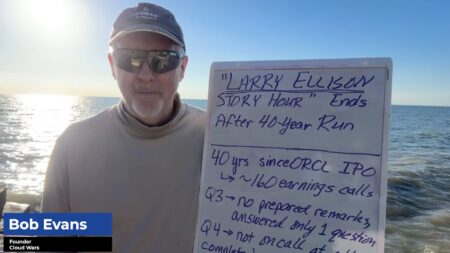


Oracle posted explosive Q3 results fueled by unprecedented demand for AI infrastructure. The company’s cloud business grew rapidly, while its data-center expansion strategy and financing plans attracted strong investor support and reinforced confidence in its long-term AI strategy.
Earnings Call
Salesforce delivered $41.5B in annual revenue and $11.2B in Q4, with Marc Benioff calling it one of the best performances in software history as AI offerings like Agentforce drive renewed growth momentum.
Salesforce posts 12% Q4 revenue growth and 14% RPO growth, signaling a confident return to high-performance execution.
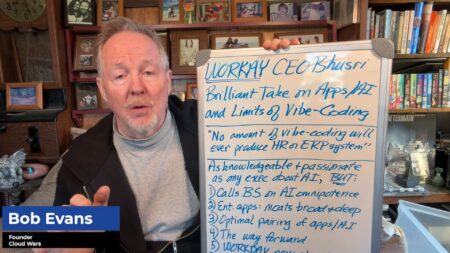
Workday’s Q4 call reframed the AI debate, emphasizing that enterprise applications remain essential even as AI accelerates innovation across HR, ERP, and beyond.
Palantir delivered stunning Q4 results, with revenue up 70% and U.S. commercial growth surging 137%, as CEO Alex Karp credited differentiated AI implementation and “magical” frontline outcomes for accelerating enterprise and government adoption.
AWS is seeing stronger-than-expected growth in non-AI workloads as enterprises accelerate cloud migrations. Jassy says both core infrastructure and AI services are driving demand, requiring rapid capacity expansion across data centers and power infrastructure.
ServiceNow CEO Bill McDermott says AI is “devouring” low-value software vendors as enterprises demand AI embedded directly into workflows. He insists ServiceNow is not SaaS but a platform company positioned to lead the Agentic AI Era.
ServiceNow’s message: We’re not in the SaaS neighborhood—we’re building the AI economy’s operating platform.
SAP outperformed competitors like Oracle and Salesforce, growing its cloud business by 200% more than some rivals.
Oracle is merging its legacy databases, apps, and infrastructure into an all-inclusive AI stack to dominate the fast-growing AI economy, according to Larry Ellison’s recent earnings call.
ServiceNow and Palantir are locked in a high-stakes battle to dominate the AI platform market and define the future of enterprise software.
Palantir’s AI momentum is being driven by CEOs eager to scale beyond pilots to full enterprise transformations.
Strategic federal wins and healthcare momentum underscore Workday’s strong Q3, with AI adoption driving customer expansions and renewed 10-year commitments.
Google Cloud’s Q3 2025 saw explosive 34% growth, a $155B backlog, and more billion-dollar AI deals than the last two years combined, cementing its rise as the AI-first cloud powerhouse.
A record-breaking quarter shows Palantir redefining how AI and data can transform entire industries.
Despite Oracle’s AI infrastructure play, SAP stays the course with a strong software-first AI strategy, avoiding multibillion-dollar CapEx.
Oracle’s Q1 results set records, but Ellison is focused on the future, predicting that AI inferencing will automate every major industry process and that Oracle is uniquely positioned to lead.
Marc Benioff refutes the “SaaS is dead” narrative with data, biblical wisdom, and a vision of AI-enhanced applications at Salesforce.
Agentic AI is driving ServiceNow and Salesforce to expand beyond their traditional domains of ITSM and CRM.
CEO Sridhar Ramaswamy confirms AI as Snowflake’s growth engine, influencing 50% of new customers and becoming central to 25% of deployments, while Q2 revenue climbs to $1.09B amid rising competition.