


Explore how Google Cloud and Thales, alongside SAP and NVIDIA, are embedding security and governance into agentic AI workflows — and why industry collaboration could be key to building a safer, more trustworthy AI ecosystem.
Explore how Google Cloud and Thales, alongside SAP and NVIDIA, are embedding security and governance into agentic AI workflows — and why industry collaboration could be key to building a safer, more trustworthy AI ecosystem.

AWS will add 2 million NVIDIA GPUs to its infrastructure in 2027 and 2028, including Blackwell Ultra, Rubin and Rubin Ultra architectures, as the cloud giant prepares for surging demand for next-generation AI workloads.

Amazon and Qualcomm Technologies have announced a multi-generational collaboration focused on customized silicon and connectivity for AI infrastructure, with Amazon potentially making up to $60 billion in payments for Qualcomm products, technology, systems and manufacturing services.

Extended, powerful partnerships will prove to be just as important as the expanding AIforce, as Salesforce challenges the traditional mindset with its approach to the future of tech.

AI security is becoming an ecosystem problem, and Workday is joining forces with major technology companies to share knowledge and strengthen protections across enterprise AI.

After proving its custom silicon strategy with Maia 200, Microsoft is preparing a much larger Maia 300 push designed to support both AI training and inference.

Google Cloud’s infrastructure strategy gives frontier AI lab Mirendil the flexibility and scale needed to speed up the AI research loop.

Microsoft and more than 20 tech companies urge U.S. lawmakers to protect open-weight AI models, arguing openness drives innovation and competition.

Palantir’s Q2 2026 results reveal 93% growth, a bold AI sovereignty strategy, and how its customer-first approach is reshaping enterprise AI.

ServiceNow has joined the fast-growing agentic AI movement with Project Arc, an autonomous desktop agent developed with NVIDIA that can execute enterprise tasks securely across multiple tools, signaling a shift beyond conversational copilots.

OpenAI has secured $110 billion in funding from Amazon, NVIDIA, and SoftBank, valuing the company at $730 billion. The investment aims to expand global AI infrastructure, accelerate frontier model development, and scale enterprise and consumer AI adoption worldwide.

Paul Swider of RealActivity said demos highlighting Microsoft’s work with NVIDIA gave important insight into AI agent and product development opportunities.
Cloud and AI are set to dominate 2026, reshaping industries from automotive to energy, with partnerships like NVIDIA and Mercedes-Benz, and strategic acquisitions like Google’s Intersect defining the next era of digital transformation.
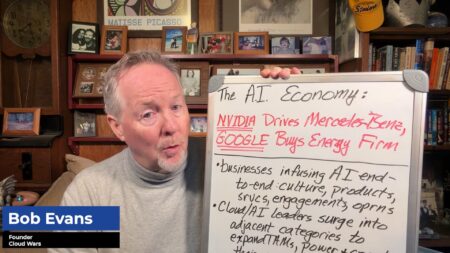
AI is no longer just a buzzword, it’s a new economic paradigm. With AI reshaping retail, automotive, and energy, leaders must choose between innovation or obsolescence.
AWS is investing $50 billion to expand AI and supercomputing infrastructure for U.S. government agencies, accelerating cloud innovation.
Mahesh Thiagarajan, Executive Vice President of Oracle Cloud Infrastructure (OCI), discusses Oracle’s vision for fulfilling customer expectations and ambitions in the AI Era.

In this interview, Palantir’s Chad Wahlquist articulates how their AI platform (AIP) is not just another product but an operating system for enterprise business, enabling global optimization across supply chain, inventory, demand, rather than local point solutions.
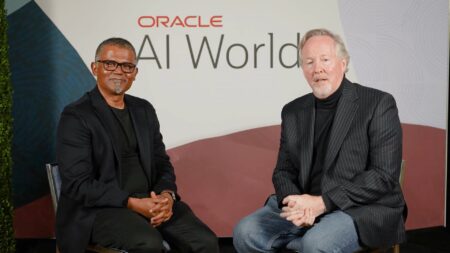
Oracle’s cloud strategy blends full-stack engineering with aggressive AI and GPU expansion.

Microsoft expands Azure AI Foundry with new OpenAI models — GPT-image-1-mini, GPT-realtime-mini, GPT-audio-mini, and GPT-5 — unlocking advanced multimodal capabilities in text, image, and audio for developers.

While Microsoft’s investment is a vote of confidence in UK AI leadership, some voices in Europe, including SAP and Siemens CEOs, warn that current EU regulations are leaving the continent behind in AI innovation.