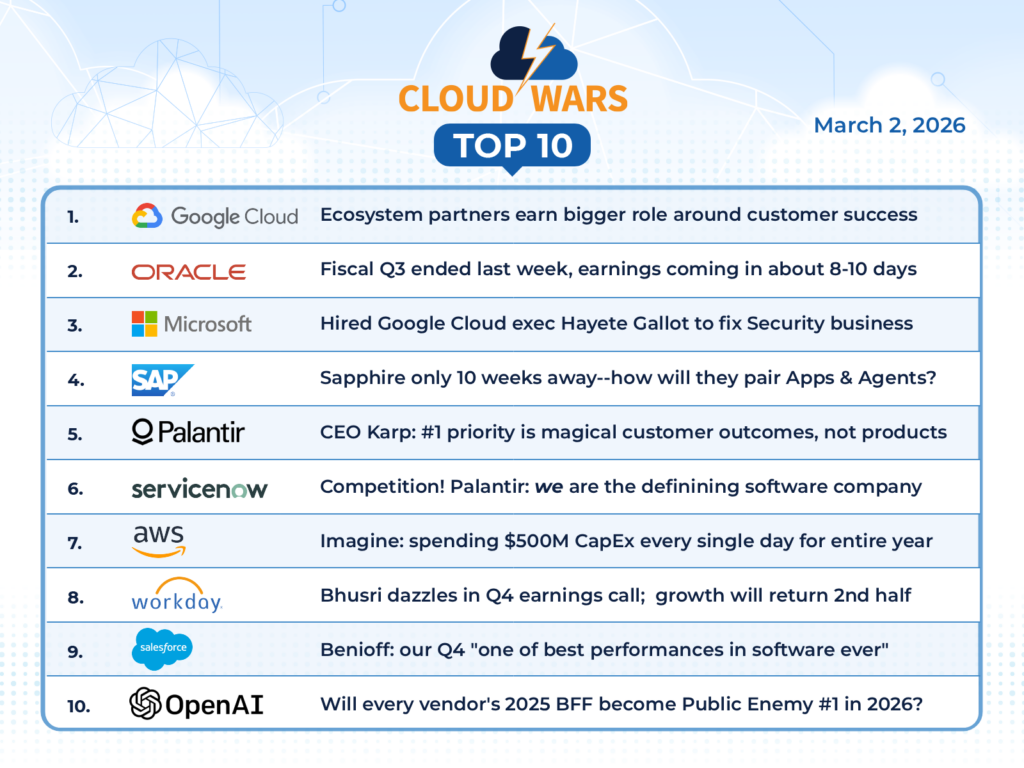



Co-founder Aneel Bhusri delivered a virtuoso performance during Workday’s Q4 earnings call by shredding the fantasy that agentic AI will obliterate the SaaS industry and clearly defining why the proper combination of apps and AI will drive superb outcomes for enterprise customers.
In returning 3 weeks ago to the CEO role he held for most of Workday’s 21 years, Bhusri jumped into a situation that is simultaneously precarious and also full of promise. Let me first mention the challenges facing Workday — all of which made his performance on the Q4 earnings call so incredibly important — and then I’ll touch on the significant upsides:
- the rise of AI in general and agentic AI in particular has rocked the SaaS industry, of which Workday is a founding member;
- the intense competition Workday faces from much-larger competitors including SAP and Oracle, as well as a new cohort of AI-native industry-specific startups;
- the public perception of a troubled company brought on by a market cap that has plummeted by more than 50% in the past 6 months;
- confusion among customers and partners about how much of a threat leading AI-model vendors such as Anthropic and OpenAI pose to Workday; and
- the inevitable disruptions caused by a change in CEOs.
On the positive side, Workday has a lot of very good things going for it:
- a large and deeply committed customer base that includes many of the world’s largest corporations;
- a product portfolio that promises customers Workday will be careful stewards of their two most-important assets: their people and their money;
- a long-standing and deep commitment to AI, with Bhusri himself being one of the earliest and most-passionate advocates;
- excellent leadership in presidents Rob Enslin (Chief Commercial Officer) and Gerrit Kazmaier (Head of Products and Technology);
- consistent and impressive growth rates;
- some recent acquisitions that show great potential in the emerging AI Economy; and
- the return of a CEO who has been since the company’s founding exactly 21 years ago not only its advanced-technology visionary but also its heart, soul, and cultural leader.

AI Agent & Copilot Summit is an AI-first event to define opportunities, impact, and outcomes with Microsoft Copilot and agents. Building on its 2025 success, the 2026 event takes place March 17-19 in San Diego. Get more details.
So against that backdrop, why was I so impressed with Bhusri’s performance on Workday’s Q4 earnings call? I can break that down into five broad themes:
1. Calling BS on AI’s omnipotence. For the past 10 years, it’s been unmistakably clear to me that no software-industry executive on Earth has more confidence in or understanding of AI than Aneel Bhusri. So that’s why his delivery of this all-time classic line — “No amount of vibe coding is going to produce an HR or an ERP system” — is so powerful and will cause some of the frothing AI-is-the-answer-to-everything fanatics to take a breath. Again, you won’t find a more-passionate nor more-knowledgeable advocate for AI than Bhusri — but at the same time, he knows better than most that AI is a tool, not a panacea. And it must therefore be applied in the right ways for the right outcomes, rather than being mistakenly expected to be able to do everything anyone can imagine.
2. Enterprise apps have staying power for a very good reason. In setting up his legendary line about the wild improbability of vibe-coded ERP, Bhusri carefully described the differences between what world-class enterprise apps have been built to do and what AI is currently capable of. “You’ve all heard the narrative out there that HR and ERP will be replaced or relegated to the background by AI. I personally just don’t see that happening. Our application domains are really, really hard to build. I’ve been working in the HR and ERP space for over 30 years. These are true systems of record that must process transactions with absolute accuracy and speed, enforce complex security models and comply with statutory and regulatory requirements all over the world. That kind of complexity is very hard to replicate. No amount of vibe coding is going to produce an HR or an ERP system.”
3. Framing the optimal pairing of apps and AI. After making the case for the ongoing value of enterprise apps, Bhusri then offered a simple but powerful explanation of how AI is enhancing and will continue to enhance — rather than rendering obsolete — the enterprise apps that run the global economy. “Importantly, our underlying business processes are deterministic by nature. There is a start and end to a business process. Its goal is to deliver consistent, auditable outcomes. AI — for all of its incredible capabilities — is probabilistic by nature. It reasons, predicts, and recommends based on patterns and likelihoods. Maybe it’ll eventually become a system that follows the same steps and gets the same result every time — but it is not there today. You can’t have probabilistic outcomes in running payroll — it needs to be 100% accurate and completed 100% of the time.”
4. Charting the way forward. “So what is the future? It’s the marriage of deterministic enterprise apps with probabilistic AI that leads to three things: a redefined user experience that is prompt-based, a greatly improved business-process automation and execution platform with work done by agents and humans; and lastly, much deeper AI-generated insights. Taken together, these changes will lead to much better business outcomes and deliver far higher ROI for our customers. As you’ll hear from Gerrit, this hybrid world and architecture is exactly what Workday is building today, marrying the best system of record for HR and finance with the reasoning capabilities of domain-specific LLMs. That’s the future. It’s like peanut butter and jelly: they just go together. And it’s all rooted in the trust we’ve built with our customers over the past 20 years from managing their systems and their most critical data.”
5. Positioning Workday in that apps/AI future. “We talk internally about this next chapter of Workday as Chapter 4. The first chapter was the founding of the company by Dave and myself back in 2005, based on the new idea of HR and finance in the cloud and built on a set of core values around employees, customers, innovation, integrity and fun. The second chapter was a period of hypergrowth that led to our success with many organizations around the world, and product and technology leadership in HR and finance. The third and most-recent chapter, which started in 2023, was all about operational excellence and efficiency as we grew into a Fortune 500 global company. Well, Chapter 4 is now upon us, and it’s a return to focusing on innovation. When we founded Workday, we transformed the enterprise by re-imagining HR and finance in the cloud. Now we have the opportunity to transform it again by re-imagining HR and finance with AI, and taking advantage of this new vector of growth.”
Final Thought
I’ll dig into Workday’s Q4 numbers and related commentary in the next week or so, but feel certain that these strategic insights from Bhusri are the most-significant outcomes from the Q4 earnings call because they provide brilliant context for where the company is headed under its once and current CEO. It’s a challenge certainly not exclusively facing Workday, as SAP and Oracle and Salesforce and Microsoft are all dealing with the same wrenching repercussions of the relentless innovation and upheaval in the Cloud Wars.