




Community Summit North America 2025 concludes today, wrapping up a week of innovation and insight across the Microsoft business applications ecosystem. Our coverage of the summit’s final sessions kept the spotlight on AI and Copilot technology. Discussions spanned from identity security and responsible AI strategy to deep dives into Copilot Studio, intelligent agents, and supply chain transformation. Across the day’s conversations, one theme stood out: AI has firmly moved from experimentation to execution and is now driving tangible impact.
Copilot Studio Tools Deep Dive
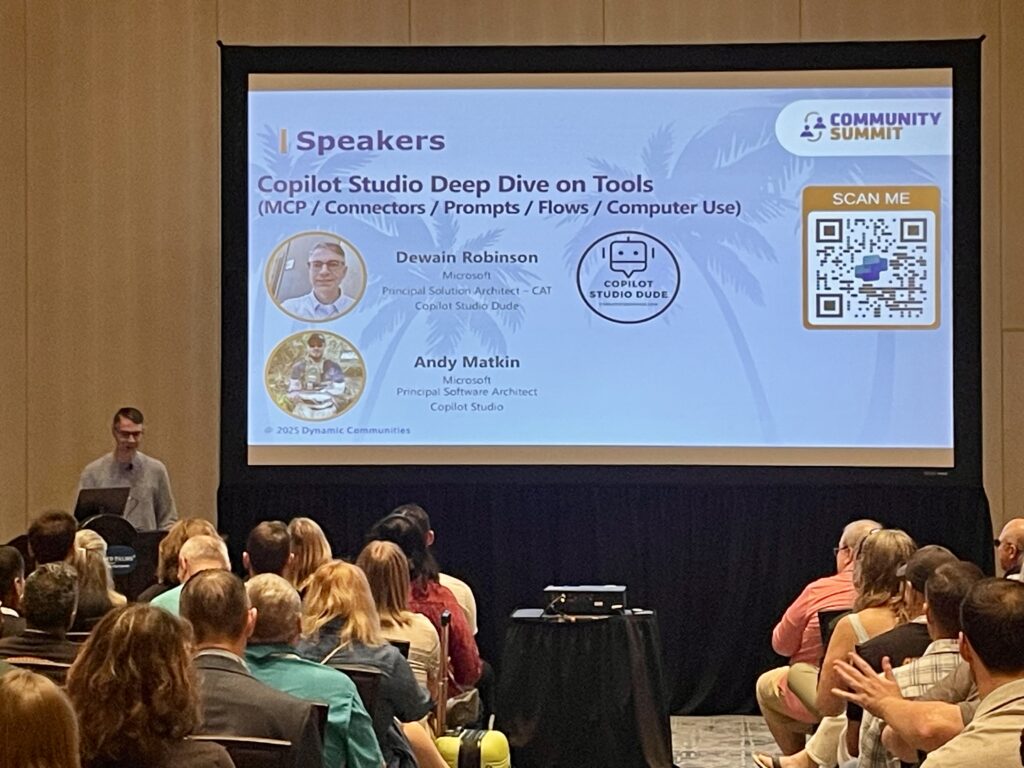
“Copilot Studio Deep Dive on Tools” was led by Dewain Robinson, Principal Copilot Studio Solution Architect at Microsoft. He was joined by Andy Matkin, Principal Software Engineer at Copilot Studio, who closed the session with a focus on Model Context Protocol (MCP). This session provided a great example of practical walkthroughs and presented content for the first time, which will be the basis for future videos on Copilot Studio.
Participants learned about the different types of tools available in Copilot Studio, when to use them, and how to implement and utilize them efficiently. While much of the conversation this week has focused on orchestration and advanced offerings, this specific session centered around tools, offering recommendations for early users in their journey.
The detailed demo highlighted areas of Copilot Studio that haven’t been extensively covered, demonstrating the learning journey that attendees experience at Community Summit throughout the four days of complete programming.
Key Takeaways
- Connectors: There are over 1,500 out-of-the-box connectors available in Copilot Studio that link Copilot with external apps and services inside and outside of the Microsoft ecosystem. Additionally, as demonstrated by Robinson, you can create custom connectors if needed and also package these connectors for use across the organization.
- Prompt Builder Integration: Prompt Builder, formerly known as AI Builder, is now integrated into Copilot Studio. It is not an add-on but is actively being developed by the Copilot Studio team, tailored to meet users’ needs as it evolves, with capabilities like code generation.
- Wording Prompts: The nuances of prompts are incredibly important. For example, the Chit Chat Generator, developed by Robinson, demonstrated how essential it is to use the prompt building environment to create an agent that can engage in meaningful conversation. This again highlights the importance of context and testing.
In the Age of AI, Identity Is Everything
In the morning session, “AI vs. Identity Security — Who’s Really in Control When It Comes to Cybersecurity?,” Fastpath Chief Security Scientist Frank Vukovits said that “traditional perimeter is fading,” and that “identity is now the frontline of defense.” With the explosion of AI agents, remote work, and cloud adoption, Vukovits argued that organizations must rethink how they define access, trust, and control.
Key Takeaways
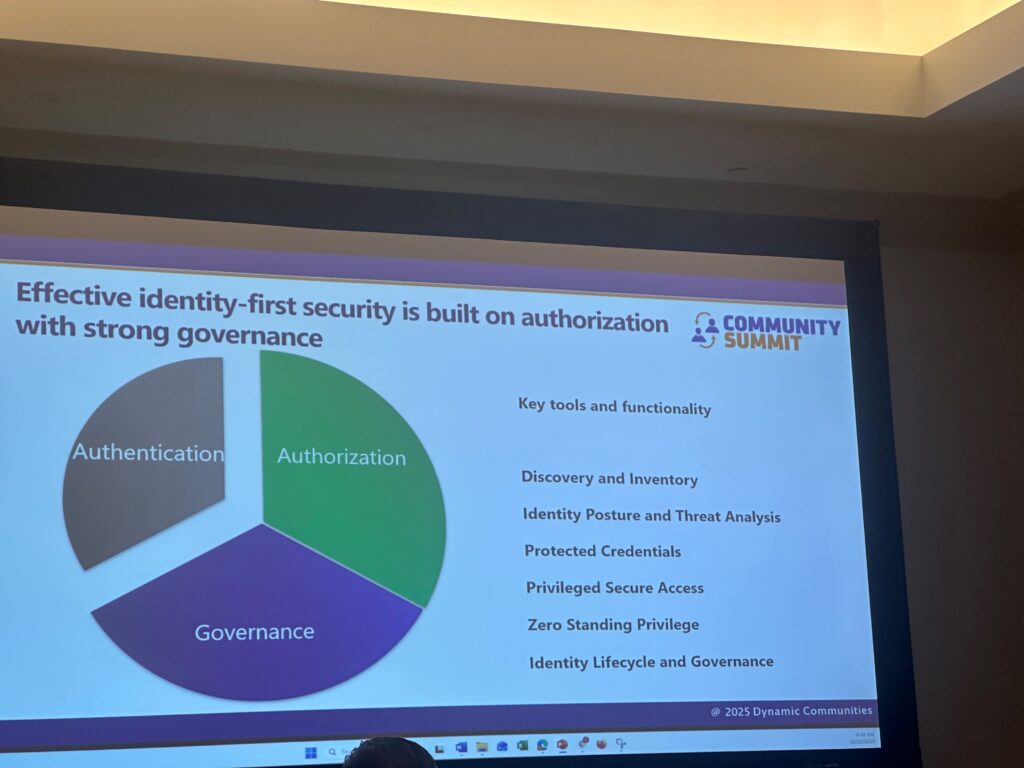
- Identity Is the New Perimeter, And It’s Getting Crowded: Vukovits categorized three critical identity types every enterprise must manage: human users (employees and contractors), privileged IT admins, and non-human identities like bots and AI agents. He pointed out that there are now 46 machine identities for every human one, and many are unmonitored, overprivileged, and capable of accessing sensitive systems.
- Authentication Is Easy. Authorization Is Dangerous: While many companies invest in strong authentication protocols, few spend as much time reviewing what a user or agent can do once inside. “Authentication is table stakes,” Vukovits said. “The real risk lies in authorization.” In an era of autonomous agents making business decisions, access control has never been more critical.
- AI Is Both Threat and Tool: AI systems can escalate threats but also help neutralize them. Vukovits pointed to emerging solutions that use AI to detect anomalous identity behaviors in real time. Still, he warned that unless we control what these agents can access, AI might secure AI or undermine it.
Empowering Supply Chains with Copilot
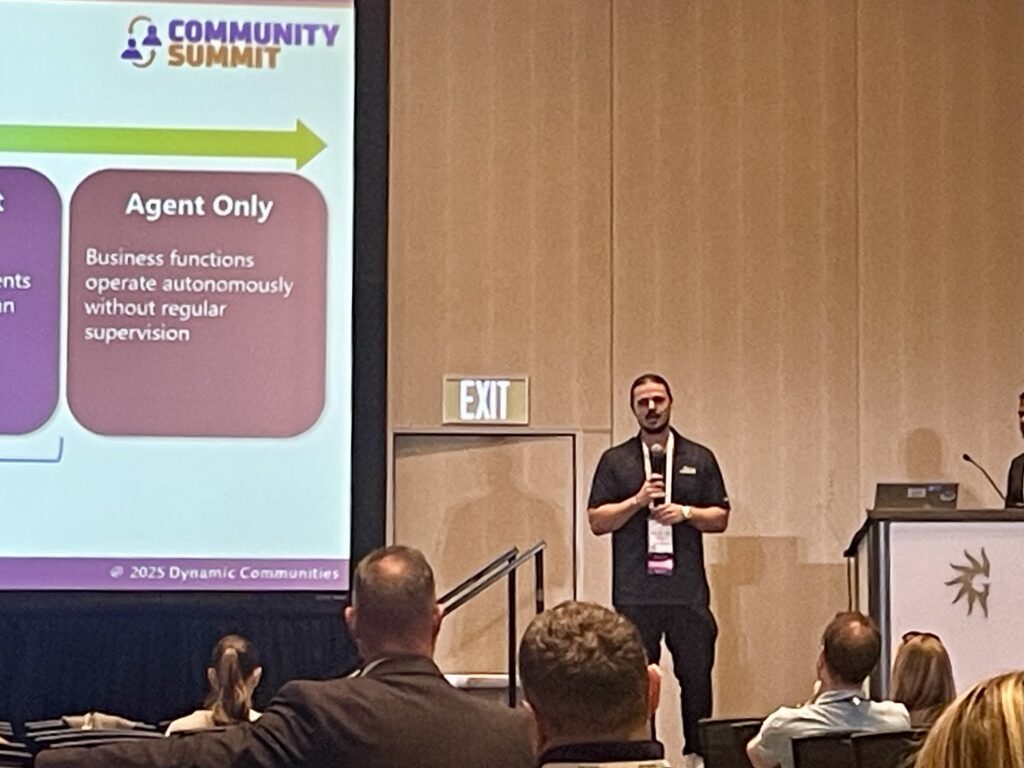
In a dedicated session, the focus was on the power of Copilot and Microsoft’s agent-based AI capabilities to enhance next-generation supply chain management. The discussion, led by Hariprasad Reddy, Dynamics 365 Manufacturing Capability Lead at Forvis Mazars, and Christian Segurado, Senior Manager of System Integration at Forvis Mazars, provided a comprehensive overview for the audience. They emphasized that understanding the business problem is crucial for defining the appropriate solution. The speakers categorized the Copilot Control System and delved into how these tools are transforming supply chain management through a comprehensive interactive demo.
Key Takeaways
- Use of Custom Agents: By using custom agents built in Copilot Studio, you can provide clear instructions for the agent to follow throughout the supply chain process. An interesting example of the agent in action is its connectivity with the Dynamics 365 ERP MCP server. This connection allows the agent to interact with various knowledge sources to retrieve specific information, such as data related to a focus warehouse.
- Human-First, Human + Agents, Agent-First, Agent-Only: Looking into the future of agentic transformation, this is the direction of travel for Microsoft technology —a more autonomous experience with workflows becoming nested agents and data becoming knowledge.
- Prompt Customization for Business Users: Built-in agents like the Supplier Communications Agent in D365 Finance and Operations offer dropdown menus for key prompt phrases, allowing general business users to tailor agent outputs without coding—streamlining outcomes across the supply chain operations ecosystem.
AI Agent & Copilot Summit is an AI-first event to define opportunities, impact, and outcomes with Microsoft Copilot and agents. Building on its 2025 success, the 2026 event takes place March 17-19 in San Diego. Get more details.
The Rise of Collaborative Intelligence
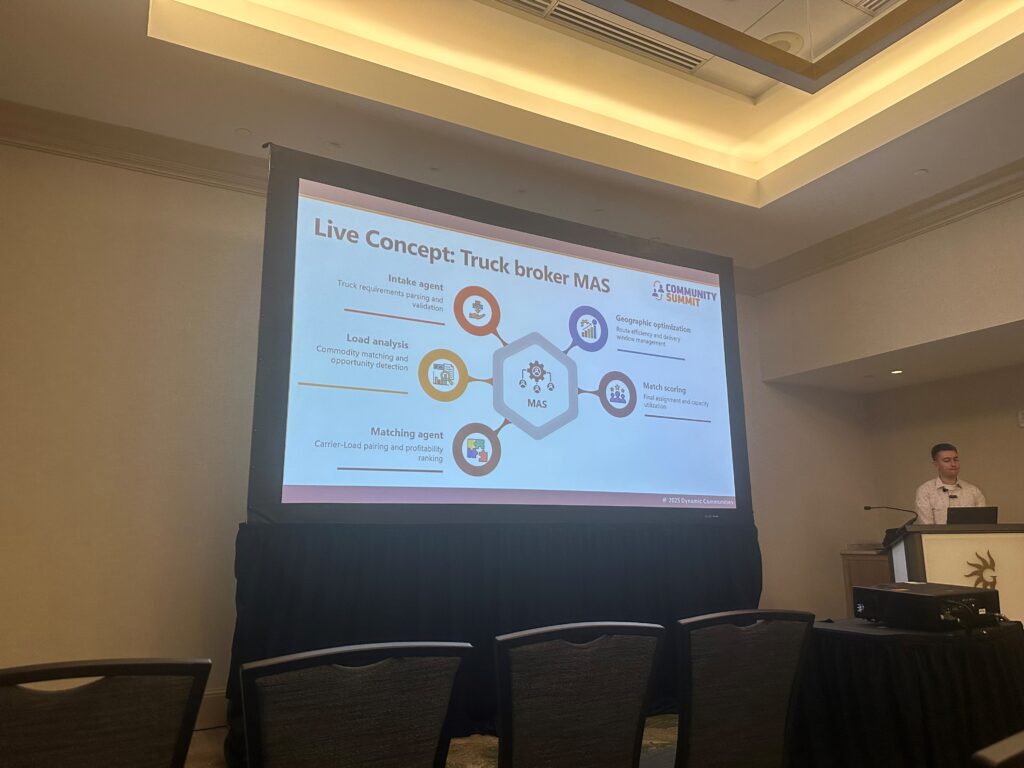
In the insightful “Smarter Together: How Multi-Agent Systems Are Shaping the Future of Intelligent Collaboration,” Bojan Culibrk and Massimo Lolli explored how multi-agent systems are revolutionizing enterprise AI by fostering smarter, more scalable collaboration across tasks and domains. Using real-world examples, like a truck brokering demo powered by orchestrated AI agents, they illustrated how distributed intelligence can tackle complex, high-volume decision-making faster and more efficiently than monolithic models.
Key Takeaways
- Specialized Agents Outperform Single Models: Multi-agent systems enable domain-specific expertise and parallel problem-solving, reducing both compute cost and decision time.
- Copilot Studio + Azure AI Foundry = Hybrid Power: Use low-code Copilot Studio for user-facing logic and Foundry for heavy-lift AI tasks, creating flexible, scalable solutions.
- Modularity Is A Strength: A well-designed multi-agent system isolates failures and enables rapid iteration, while still supporting enterprise governance and observability.
An Advanced Look at Copilot Studio
In one of the final sessions of the day, “Advanced Agent Building in Copilot Studio,” Dewain Robinson, Principal Copilot Studio Solution Architect at Microsoft, took the stage again to discuss Copilot Studio. This session built on his earlier presentation on the same topic. However, instead of covering the basics, Robinson delved into the granular functionality of Copilot Studio, referencing and demonstrating the advanced capabilities of the latest upgrades to the agent-building suite. Sessions at the Community Summit are incredibly varied in scope, catering to different levels of understanding and real-world experience among the audience. This session was definitely aimed at well-qualified users looking to elevate their experiments with Microsoft’s agent infrastructure to the next level.
Key Takeaways
- Greater Control for Developers: Demonstrating some of the new nodes released in Copilot Studio, Robinson showed how Microsoft was giving developers greater control over every level of agent creation. For example, the Custom Search node enabled users to search for knowledge and receive results in their raw format, rather than summarized data.
- New Feature Expands Knowledge Base: In response to user requests, Robinson explained how the Copilot Studio team had introduced a new feature that allows developers to upload groups of files and add names, instructions, and descriptions to inform the agent. This means that the agent can reference multiple files dedicated to a single purpose or knowledge base simultaneously.
- BYOM: Robinson also took a deep dive into one of Copilot Studio’s most talked-about new additions, Bring Your Own Model (BYOM) with Azure AI Foundry. He explained that the team decided to remove the ability to use BYOM for response generation and instead focused on BYOM for prompts. With this feature, it is very straightforward to instantly edit the nature of the agent’s output, as demonstrated live by Robinson.
Final Thought
The overwhelming message of the day was that Microsoft Copilot Studio is rapidly becoming the go-to platform for users looking to accelerate their journey in agentic AI. There was a strong emphasis on the do-it-yourself aspect of the technology, with many speakers and sessions explicitly stating, “If you don’t like the off-the-shelf product, create a custom version of the tool you need.” Microsoft has worked hard to make this endeavor a reality, not just for advanced users, but also for business users through Copilot Studio Lite.
Kieron Allen and Maya Rock contributed to this report.
Ask Cloud Wars AI Agent about this analysis