

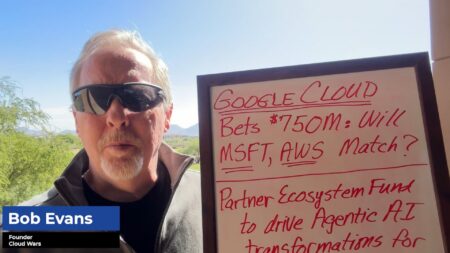
Google Cloud’s $750M ecosystem investment and major AI push signal an aggressive move to lead the agentic AI transformation race among hyperscalers.
Google Cloud’s $750M ecosystem investment and major AI push signal an aggressive move to lead the agentic AI transformation race among hyperscalers.
SAP’s surging cloud growth and backlog expose the widening gap between AI-doom narratives and the strong reality of enterprise applications in the agentic AI era.

While many predict AI will destroy enterprise software vendors, SAP’s Q1 2026 results tell a different story: cloud revenue rose 27%, Cloud ERP Suite grew 30%, and backlog climbed 25%, proving strong momentum.

Oracle EVP Steve Miranda shares the company’s agentic AI vision, introducing its first Agentic Applications and explaining how AI agents are reshaping enterprise workflows.
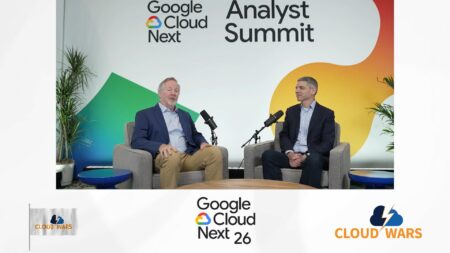
Enterprises must redesign data platforms so autonomous AI agents can reason, act, and securely drive business outcomes across the organization.

A major focus for sa.global is building industry-specific AI agents tailored to professional services sectors like construction and legal, aiming to reduce inefficiencies, automate workflows, and protect revenue streams.
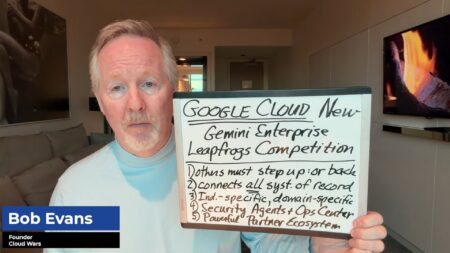
At Google Cloud Next, Gemini Enterprise emerges as a major step forward in enterprise AI, combining integrated data access, industry agents, advanced security, and partner innovation into a simplified, end-to-end platform.
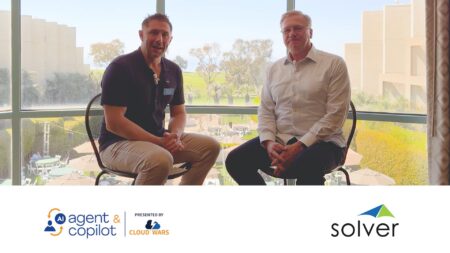
Tad Remington explains how Solver is embedding AI agents into FP&A workflows, enabling organizations to analyze trusted, pre-structured financial data and streamline planning processes without requiring extensive manual intervention or custom-built systems.

Microsoft and Publicis Groupe are expanding a long-running partnership to create a full-stack marketing solution powered by cloud, agentic AI, and identity-based data, helping marketers automate workflows, modernize legacy systems, and unlock faster, smarter growth opportunities.

AI disruption is shifting from workforce layoffs to CEO accountability, as companies demand faster, decisive leadership to survive the transformation reshaping every industry.

Latest MCP product from Microsoft works with cloud or on-premises SQL databases for efficient, secure connections to corporate resources without requiring language or framework expertise.
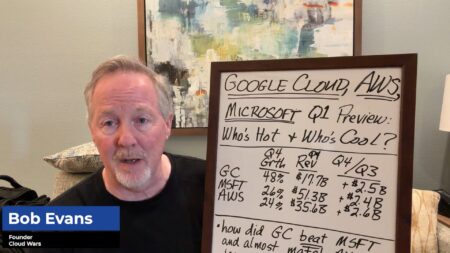
Despite Microsoft and AWS dominating in scale, Google Cloud’s Q4 performance suggests it may be capturing a disproportionate share of new enterprise cloud and AI workloads.
Google introduces Gemma 4, an advanced open AI model series designed for local deployment. With mobile-first capabilities, multimodal processing, and strong reasoning, it empowers developers to build scalable AI applications without relying on cloud infrastructure.
Round of enhancements also includes simplified prompting during agent-building processes, new content moderation controls to govern sensitive material.

Microsoft’s $10 billion Japan investment underscores a strategy combining AI infrastructure, workforce development, and data sovereignty to drive global growth while meeting increasingly strict regional compliance requirements.

Initial release supports actions across agents, multiple AI models, and interoperability through the two most widely embraced interoperability standards.
New metrics provide visibility into usage patterns, while expanded controls improve governance over content sources in Purview platform.

A podcast discussion between Chander Vaidyanathan, John Siefert, and Morgan Jonnson highlights the role of AP automation in reshaping the modern finance function.

New features enhance research quality by using multiple models to produce outputs while comparing and refining results, as well as optimizing presentation of research results.

Microsoft’s 2026 Release Wave 1 introduces deeper Copilot integration, expanded agentic AI experiences, and new governance and automation capabilities across Dynamics 365, Power Platform, and Microsoft 365 Copilot, accelerating the shift toward enterprise-wide agentic operations.