


Explore how Google Cloud and Thales, alongside SAP and NVIDIA, are embedding security and governance into agentic AI workflows — and why industry collaboration could be key to building a safer, more trustworthy AI ecosystem.
Explore how Google Cloud and Thales, alongside SAP and NVIDIA, are embedding security and governance into agentic AI workflows — and why industry collaboration could be key to building a safer, more trustworthy AI ecosystem.

Claude for Financial Advisors adds to an expanding set of industry-optimized AI software that automates and streamlines core functions performed by financial pros.

Google’s reported shutdown of its open-source bug bounty program reveals how AI-generated security reports are overwhelming cybersecurity teams and creating new challenges for vulnerability detection.

Workday launches Total Benefits, an AI-powered platform that simplifies benefits administration, empowers employees with personalized guidance, and signals a shift toward continuous, agentic AI-driven HR experiences.

Rather than forcing enterprises to integrate numerous complex modernization technologies themselves, Google Cloud is combining existing tools and new agentic AI capabilities into an end-to-end architecture designed to dramatically accelerate legacy technology transformation.
AI leaders are embracing self-regulation as Washington weighs stronger oversight, raising questions about enforcement, consumer risk, and how the U.S. can regulate AI without slowing innovation.
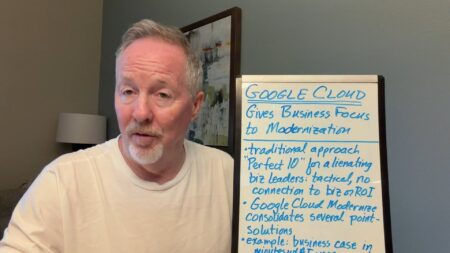
Google Cloud is simplifying enterprise modernization with an AI-driven, end-to-end approach that can shrink complex business-case processes from weeks to minutes.

Microsoft has distilled lessons from hundreds of internal AI transformation projects into five principles focused on business outcomes, end-to-end workflow redesign, employee involvement, expanded human capabilities, and continuous learning between people and AI.

Microsoft and ServiceNow illustrate a larger AI shift toward open protocols, governance, and control as enterprises seek to deploy agents across increasingly ambitious initiatives.

SoftBank plans to borrow over $11 billion through bonds to help fund a $10 billion OpenAI investment, signaling extraordinary confidence in the AI company.

Five months after unveiling Autonomous Enterprise, SAP is accelerating its agentic AI strategy with Joule solutions spanning finance, supply chain, HR, procurement, and customer experience while increasingly targeting high-value, industry-specific business scenarios.
Michael Simms discusses the importance of data readiness in the successful adoption and use of AI.

Copilot Studio feature called Hooks adds certainty to the launch of workflows by agents, rather than rely on agents to make a judgment call.
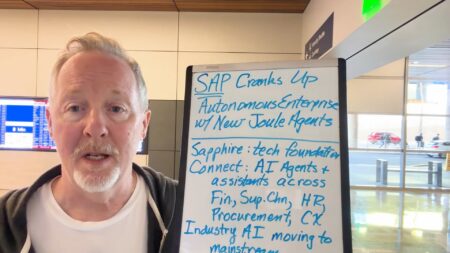
SAP is expanding its autonomous enterprise vision at Connect with AI-powered agents designed to connect business functions, data, governance, processes, and decision-making end to end.

AWS is expanding its custom-silicon strategy through a $1 billion agreement with Synopsys, potentially enabling enterprise applications from SAP, Salesforce, Workday, and other ISVs to achieve significantly higher performance through chips optimized specifically for application workloads.

Insights in Foundry analyzes “traces” to determine likely causes of mistakes by AI agents and recommend ways to overcome them.
AI is accelerating demand for always-available networks, but the underlying connectivity foundation must remain adaptable enough to support whatever technology comes next.
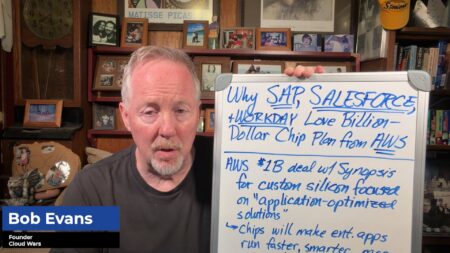
AWS’s billion-dollar Synopsys deal could bring application-optimized chips to enterprise software, strengthening AWS’s relationships with SAP, Salesforce, Workday, and their customers.

Enterprises are getting better at identifying valuable AI projects, putting pressure on pilots, products, and vendors that cannot demonstrate meaningful returns on investment.
With Copilot Managed Runtime now in public preview, Microsoft is giving apps built in Lovable and other third-party tools a governed path into the Microsoft 365 tenant, separating where apps are built from where, and how, they run.