

Oracle’s enterprise AI strategy emphasizes measurable business outcomes, scalable agentic innovation, and stronger customer partnerships as organizations accelerate AI adoption while managing costs and security.
Oracle’s enterprise AI strategy emphasizes measurable business outcomes, scalable agentic innovation, and stronger customer partnerships as organizations accelerate AI adoption while managing costs and security.

Google’s latest European research initiative signals a shift toward collaborative AI innovation, where technology developers provide the tools and scientific institutions establish the priorities for discovery.
Oracle Fusion Claw introduces a governance-first approach to enterprise AI, embedding policies, guardrails, risk limits, and auditable execution records into agentic workflows designed to solve complex business problems across critical enterprise functions.

As part of Community Summit NA, RSM and Community Summit brought together business, finance, and technology leaders for an exclusive…

Artificial intelligence is creating new business categories, disrupting traditional e-commerce, and empowering entrepreneurs to build products and services with unprecedented capabilities.
Workday accelerated its agentic AI transformation at Rising 2026, unveiling six major innovations spanning autonomous agents, unified data, governance, and workforce intelligence while strengthening its competitive position against SAP, Oracle, and Microsoft.

Proactive AI agents are transforming how businesses operate and sell products. Microsoft’s Dona Sarkar explains why companies must restructure innovation teams, simplify websites for AI-powered purchasing, and prepare for agents to become customers.
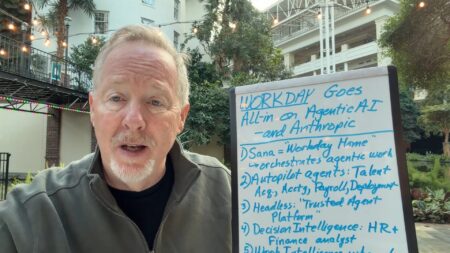
Workday doubles down on agentic AI at Workday Rising, unveiling Sana, four autopilot agents, and new intelligence capabilities designed to accelerate enterprise automation and strengthen its competitive position.
Google Cloud CEO Thomas Kurian revealed 12 powerful Gemini Enterprise customer success stories, highlighting extraordinary AI ROI, productivity gains, and cost savings as nearly 90% of Fortune 100 companies adopt the platform.

Google Cloud’s Gemini Agent combines personal AI capabilities with enterprise-grade governance, multicloud connectivity, and model flexibility. CEO Thomas Kurian believes these integrated features will help organizations deploy sophisticated AI agents more efficiently and affordably.

Procurement leaders expect AI to drive innovation and accelerate core processes, but first they need to reinvent their operations and get their people on board.

Explore how Google Cloud and Thales, alongside SAP and NVIDIA, are embedding security and governance into agentic AI workflows — and why industry collaboration could be key to building a safer, more trustworthy AI ecosystem.

IBM research finds that financial institutions expect major gains from agentic AI but must redesign outdated operating models, integrate data, and establish accountability across workflows to realize those benefits.

Google’s reported shutdown of its open-source bug bounty program reveals how AI-generated security reports are overwhelming cybersecurity teams and creating new challenges for vulnerability detection.

Rather than forcing enterprises to integrate numerous complex modernization technologies themselves, Google Cloud is combining existing tools and new agentic AI capabilities into an end-to-end architecture designed to dramatically accelerate legacy technology transformation.

SoftBank plans to borrow over $11 billion through bonds to help fund a $10 billion OpenAI investment, signaling extraordinary confidence in the AI company.

Five months after unveiling Autonomous Enterprise, SAP is accelerating its agentic AI strategy with Joule solutions spanning finance, supply chain, HR, procurement, and customer experience while increasingly targeting high-value, industry-specific business scenarios.
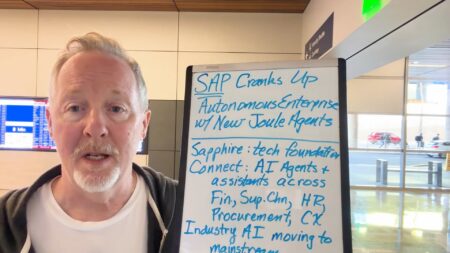
SAP is expanding its autonomous enterprise vision at Connect with AI-powered agents designed to connect business functions, data, governance, processes, and decision-making end to end.

AWS is expanding its custom-silicon strategy through a $1 billion agreement with Synopsys, potentially enabling enterprise applications from SAP, Salesforce, Workday, and other ISVs to achieve significantly higher performance through chips optimized specifically for application workloads.

AI demand is propelling the Cloud Wars Top 10 to extraordinary growth, led by Palantir at 93%, Google Cloud at 82%, and Oracle at 62%, with all three companies also demonstrating sustained quarterly growth acceleration.