


AI leaders are accelerating their push into vertical industries through customer-designed products, deeper data integration, and industry-specific skills.
AI leaders are accelerating their push into vertical industries through customer-designed products, deeper data integration, and industry-specific skills.

At Salesforce Dreamforce, Sam Altman discussed the accelerating capabilities of AI models, the risks of concentrated power, and the need for safety, while offering a striking account of OpenAI’s involvement in a Hugging Face security incident.

Marc Benioff’s AI-centered vision combines enterprise data, autonomous software, major technology partnerships, and new use cases spanning logistics, IT service management, government, and other business functions.

Work IQ could address one of enterprise AI’s biggest obstacles: agents that lack business context. Microsoft is using existing applications, processes, semantic models, and institutional knowledge to create a reusable intelligence foundation for Copilot and agents.

A new AI safety framework for U.S. schools prohibits student and educator data from being used for AI model training while establishing requirements for human oversight, transparency, privacy, and accountability from participating technology providers.

Extended, powerful partnerships will prove to be just as important as the expanding AIforce, as Salesforce challenges the traditional mindset with its approach to the future of tech.

Google’s Fairwind Program combines CodeMender with Gemini-powered cybersecurity AI to help 650+ trusted organizations discover vulnerabilities, generate verified patches, and automate security remediation.

New functions can support apps that combine Dynamics 365 apps with business context from WorkIQ for complete experiences, Microsoft partners say.
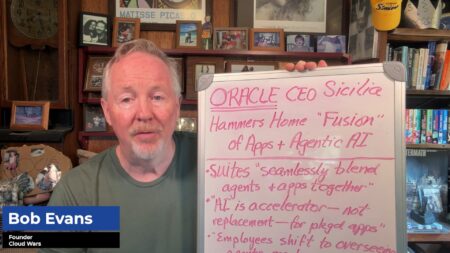
Oracle has been clear in defining where apps end and agents end, with CEO Mike Sicilia driving it home in comments in the Q1 earnings call.

Oracle has become the second-fastest growing hyperscaler, with Q1 revenue and growth rates making a major jump.

Oracle’s Q1 cloud revenue and OCI growth rate have jumped this quarter. How can its business model innovation propel the company to rise even higher?

As AI becomes more powerful and autonomous, Microsoft is expanding its responsible AI approach with stronger access controls, agent monitoring, telemetry, memory management and safeguards designed to address increasingly complex interactions between models, tools, data and users.

Oracle delivers a blowout Q1 as cloud infrastructure revenue surges 121% and its $664 billion RPO nearly matches Microsoft’s massive backlog.

Google Cloud CEO Thomas Kurian says general-purpose AI alone cannot meet complex industry requirements, prompting the company to surround Gemini Enterprise with specialized skills, trusted data connections, agentic workflows, governance, and partner solutions.
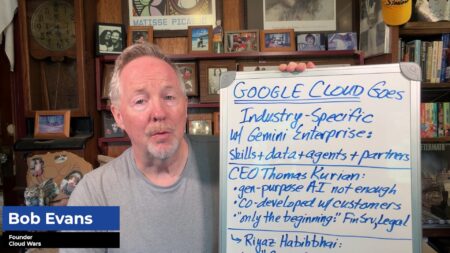
Google Cloud is taking Gemini Enterprise deep into vertical industries, beginning with financial services and legal and combining skills, data, agents, and partners into one AI system.

Instead of searching across laboratory results, medications, and specialist documentation, clinicians can prompt Epic and receive required information inside ChatGPT using new OpenAI connector.
Since returning as CEO, Aneel Bhusri has reshaped Workday’s agentic AI strategy, eliminating or combining simpler agents while prioritizing sophisticated AI systems capable of solving complex HR and finance problems and delivering measurable customer ROI.

OpenAI prominently outlined plans for a unified AI superapp in March, but CFO Sarah Friar’s August description of the company’s AI-native stack makes no mention of it, raising questions about whether OpenAI has changed its strategy.

ServiceNow CEO Bill McDermott is positioning cybersecurity as a major growth engine, combining rapid security-business expansion, strategic acquisitions, new leadership, and Autonomous Security while maintaining the company’s broader identity as the AI control tower for business reinvention.

ServiceNow is rapidly building its cybersecurity presence, and three recent developments suggest Bill McDermott may see security as the company’s defining long-term opportunity.