

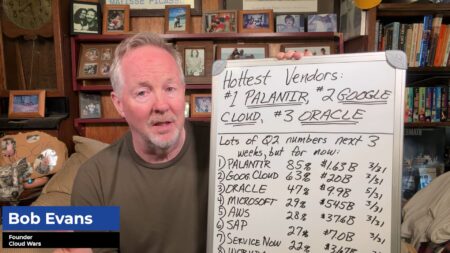
Palantir leads the latest Cloud Wars rankings as Bob Evans previews Q2 earnings and explains why cloud and AI remain the world’s fastest-growing technology market.
Palantir leads the latest Cloud Wars rankings as Bob Evans previews Q2 earnings and explains why cloud and AI remain the world’s fastest-growing technology market.

AI is dramatically accelerating software development, but Cedric Wells argues that organizations must balance rapid innovation with architecture, security, governance, and quality assurance to safely move AI-generated solutions into production.

Salesforce’s latest AI announcement combines autonomous customer support, responsible AI governance, and a pricing model built around delivering successful business outcomes.

The world’s largest cloud providers are embracing innovative financing, partnerships, and infrastructure strategies as unprecedented AI demand drives what may become the largest industrial construction effort in modern history.

Autonomous agent or ‘autopilot’ – touted for executing high-level autonomous tasks – now offers improved usability and model choice.

Hyperscalers are embracing unprecedented financing strategies and partnerships as AI demand forces massive investments in next-generation data center infrastructure.

SAP is partnering with Giotto.ai to evaluate reasoning-focused AI models that could make Joule agents more reliable, secure, and effective in complex enterprise decision-making.

The AI Deployment Wars are expanding beyond technology into branding. Microsoft’s ambitious Frontier Company contrasts sharply with AWS’s practical Forward Deployed Engineering, raising questions about which message resonates with enterprise executives.

A new generation of AI-powered enterprise applications combines reasoning, workflow automation, and transactional execution.

AWS and Microsoft are taking radically different branding approaches to AI deployment, raising questions about which strategy enterprise customers will embrace.

As AI transforms cybersecurity, Oracle is helping customers protect data through faster patching, stronger resilience, and database-first security.

Google Cloud is separating itself from Microsoft and AWS by relying entirely on partners to deliver enterprise AI deployments and agentic transformation.

Solgari’s Ed Grant explains why customer engagement data is the foundation of successful AI strategies and how organizations are turning conversations into business outcomes.

The next wave of enterprise AI will depend less on models and more on governed, connected data and operational context, according to Salesforce and Databricks.

The world’s leading AI companies are investing nearly $10 billion to ensure AI deployments generate measurable business outcomes rather than simply impressive technology.

Microsoft’s new Frontier Company represents the company’s biggest step yet toward making its frontier firm vision a reality for enterprise customers.

Palantir challenges traditional ERP and standardization, suggesting an alternate approach in the current economy and age of AI.

Microsoft is shifting Copilot Cowork to usage-based pricing while exploring lower-cost AI models, signaling a strategy focused on performance, economics, and customer choice.

Working with DynaTech Systems, Solmax standardized global business processes and created a single source of truth, helping eliminate data silos and improve financial and operational decision-making across multiple regions.

Enterprise AI growth increasingly depends on implementation expertise rather than model capabilities alone.