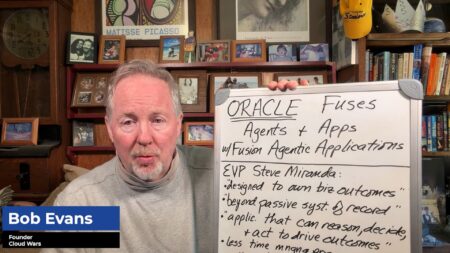



In this episode of Cloud Wars Live, Bob Evans speaks with Steve Miranda, Executive Vice President of Applications Development at Oracle, about the company’s latest leap into AI-driven enterprise software. Miranda outlines Oracle’s introduction of “agentic applications,” a new category that blends AI agents, automation, and business workflows into outcome-driven systems. He explains how Oracle’s strategy has evolved from embedding AI into apps to building thousands of agents — and now to delivering fully agentic apps that transform how users interact with enterprise software. The conversation highlights both the opportunity and confusion customers face in this rapidly shifting AI landscape.

Rise of Agentic AI
The Big Themes:
- From Features to Outcomes: A major shift is the move from feature-based software to outcome-driven systems. Instead of executing predefined tasks, AI agents are now given business goals, such as optimizing supply chains or improving financial performance, and they generate multiple strategies to achieve them. Users then act as decision-makers, selecting preferred options. This represents a profound change in human-computer interaction, where software becomes a collaborative partner.
- Explosive Growth of AI Agents: Oracle’s rapid expansion from around 50–100 agents to over 1,000 demonstrates the accelerating pace of AI adoption. This growth reflects both customer demand and the scalability of AI-driven architectures. The agents are not limited to simple automation but are capable of reasoning, analyzing enterprise-wide data, and making recommendations. This scale also lays the foundation for agentic applications.
- Future of SaaS Reimagined: Miranda makes it clear that SaaS is undergoing a fundamental transformation. Traditional applications will coexist with agentic systems for now, but the long-term trajectory points toward AI-driven interfaces becoming dominant. Oracle plans to expand agentic capabilities across its entire application suite, from finance to supply chain to HR. As AI-to-AI interactions and data integration improve, these systems will become even more powerful.
The Big Quote: “These are agents where you’re giving the agent a business outcome and a goal, and the agents [are] recommending to you optimizations or how you get there. And then you, as a user or human in the middle of this process, actually instruct those agents on which of the plans to execute, and it goes ahead and automates and executes those transactions. So it’s a fundamentally different way of presenting the applications.”
More from Steve Miranda:
Connect with Steve on LinkedIn or learn more about AI agents for Fusion Applications.