

In one of the boldest moves in Salesforce’s 27-year history, Marc Benioff is putting the world’s largest enterprise-apps business plus its $800-million agentic AI business under the orchestration of a new UI called Slackbot being positioned as the “front door to the Agentic Enterprise.”
Benioff’s strategy is that the wild new world of AI requires a radically different approach in how businesses deploy technology to innovate and grow.
How radical? Well, cofounder Parker Harris said that the new way of working with Slackbot is so profound that it is, in his words, “disintermediating Salesforce.”
Now, I’m not sure if customers will find that remark reassuring or alarming — and I’ll go into Harris’s comment with more context and detail in a moment.
Because for executives betting their businesses on their technology decisions, “radical” can be okay so long as it is paired inextricably with technology that is trustworthy, demonstrable, and capable of happening in real time rather than on some prehistoric multi-year timetable.
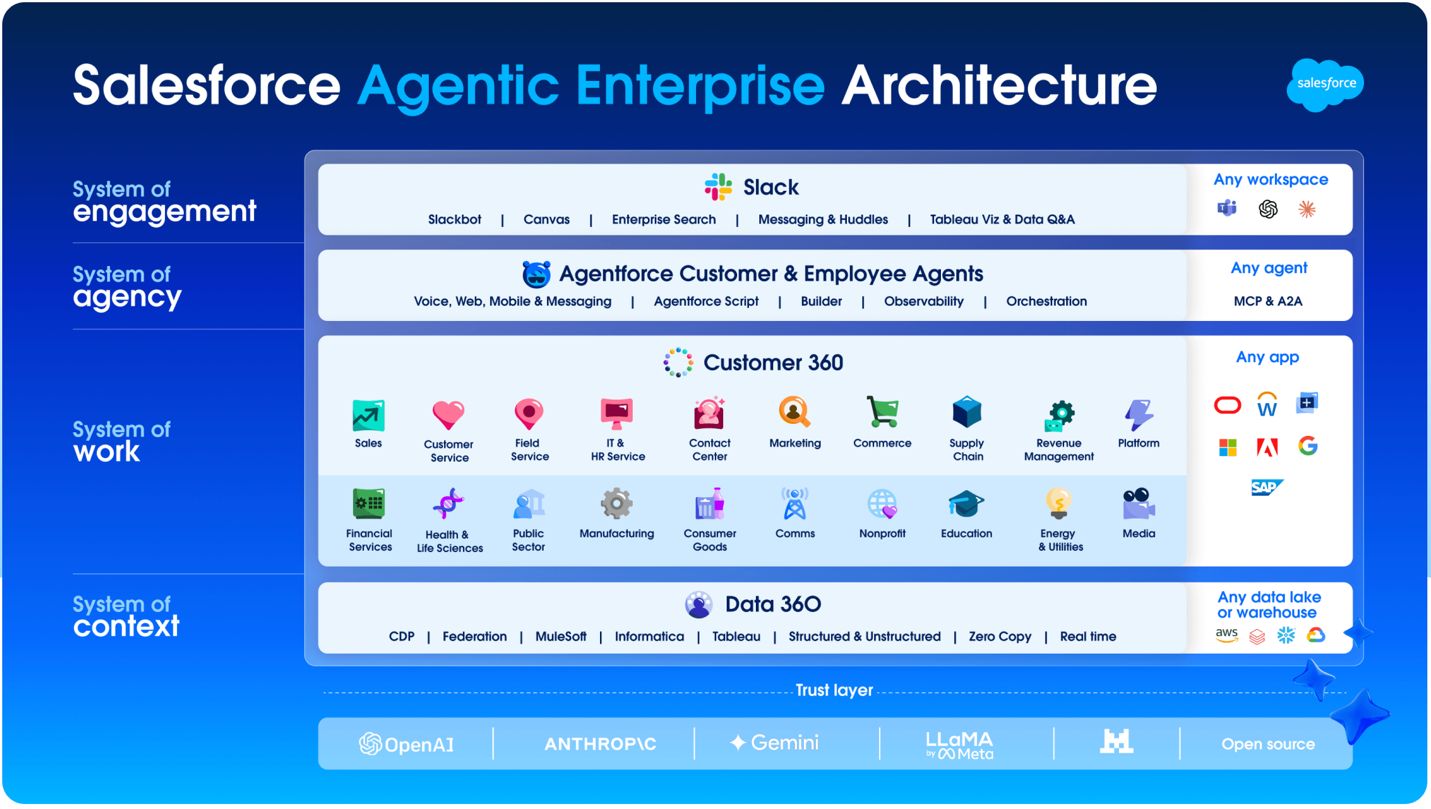
So with Slackbot at the helm, Salesforce is promising its customers that it can deliver a seamless and growth-oriented approach to enterprise software that delivers — simultaneously — a system of engagement, a system of agency, a system of work, and a system of context.
True to his nature, Benioff presented this radical-but-practical new model with a nice rhetorical flourish, saying that it offers safe transport to those companies caught on the wrong side of what he called “the agentic divide.”
“We’re going to this incredible new world of the Agentic Enterprise,” Benioff said in his opening remarks at the Slackbot launch last week.
“Being an Agentic Enterprise, all of a sudden you have a supercharged business: a system of context, a system of work, a system of agency, and a system of engagement, all front-ended by Slack,” which serves as “your operating system.”
And business leaders who aren’t convinced that the Agentic Enterprise represents the land of milk and honey could find themselves wandering in the wilderness as competitors move more rapidly and more intelligently, grabbing market share and future opportunities along the way.
“We have an incredible tiger by the tail with Agentforce — it’s our fastest-growing product ever with more than $800 million in fourth-quarter ARR,” Benioff said while thanking the 23,000 customers that have adopted Agentforce.
“It’s been out for a couple of years, so we know there is still very much what we call the ‘agentic divide’ between those who’re having these great experiences with their customers and the many companies who have not yet crossed this chasm,” Benioff said.
“And we think that in this moment of transformation, one of the things that will help customers move through the agentic divide is Slack.” Benioff mentioned Slack’s impressive record of growth since Salesforce acquired it five years ago for $27 billion:
- about 1 million customers running on Slack;
- Slack revenue up 2.5X since the acquisition; and
- up 3X by the end of Salesforce’s fiscal year on Jan. 31.
Cofounder Harris: Slack Is “disintermediating” Salesforce
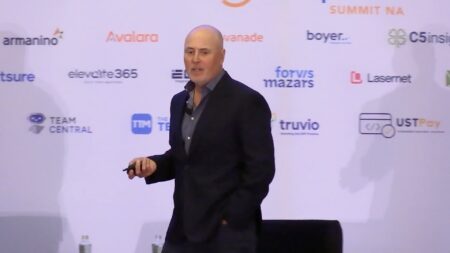
Noting that he got directly involved with the Slack business unit two years ago, cofounder Parker Harris joined Benioff on the keynote stage and opened with this remarkable perspective:
“Slackbot is the fastest growing feature I have ever seen at Salesforce, maybe in the industry. It is unbelievable.”
To underscore the significance of the huge new role Slackbot is being given, Harris brought up an idea that until very recently would have seemed inconceivable.
“We have CRM built into Slack for small businesses — that’s out right now,” Harris said.
“But we’re not stopping there because we’re actually disintermediating Salesforce while we do this. We are basically saying, ‘Why should you ever log into Salesforce again?’ ” Harris mused.
“Maybe you never will. Maybe you will go into Slack because Slack is that new engagement layer for enterprise software for developers and it’s also where you’re going to get the AI help.”
And the impact will be felt everywhere, not just by developers, Harris said.
“So sales is different: deals are closing more quickly. Service, field service, IT service, HR — everything is changing, every single thing.
“If it’s not changing fast enough, I guarantee you Marc will be beating people over the head in Salesforce and saying, ‘Why are you not going faster?!?’
“Slack is also where you manage Agentforce. Slackbot is your employee super-agent,” Harris said.
Final Thought
Think about the changes taking place across the top-tier enterprise applications company in just the past six months:
- Salesforce elevates Slackbot to the top of its stack and thereby invites itself to be disintermediated;
- Oracle releases 22 Agentic Applications with the promise of many more to come;
- Workday releases its end-to-end Sana AI; and
- SAP overhauls its pricing model in recognition of the new ways in which AI is changing how customers are using enterprise software.
Seems like a good opportunity for business leaders to give very honest answers to a simple question: is my company changing as fast as the world around me, or am I falling behind in an environment where catching up is more difficult than ever before?
Ask Cloud Wars AI Agent about this analysis