


On the strength of customer design partnerships and an expansive ecosystem, Google Cloud delivers AI platforms that could unlock AI innovation in support of vertical use cases.
On the strength of customer design partnerships and an expansive ecosystem, Google Cloud delivers AI platforms that could unlock AI innovation in support of vertical use cases.

Google Cloud and Mahindra are bringing Gemini Enterprise directly into vehicles, demonstrating how AI is moving beyond traditional digital environments and becoming embedded in physical-world endpoints.

Consolidated AI chatbots raise order values up to 26% at Albertsons, while WalMart’s in-store AI use requires employees to further train AI models with business context.

Palantir’s growth accelerated from 71% to 85% to 93% over three quarters as customer demand, expanding contracts, and a distinctive value-based pricing model fuel momentum.

Palantir’s rapid growth reflects an enterprise AI strategy centered on measurable customer outcomes, operational transformation, sovereignty, and deep long-term partnerships.

Enterprise AI’s next breakthrough will come from evaluating agents against real business workflows and continuously improving their performance with proprietary organizational knowledge.

Agentic reasoning loops promise better AI answers, but could dramatically increase token consumption and costs as enterprise adoption grows.

Oracle lands a major 10-year Pentagon contract worth up to $7 billion, strengthening its government credentials while creating a potentially significant stream of recurring revenue.

July updates extend the company’s commitment to make a range of AI models and choices available to users. Models from OpenAI and Anthropic have been added.

Google has introduced Gemini 3.6 Flash, Gemini 3.5 Flash-Lite, and Gemini 3.5 Flash Cyber, focusing on lower costs, faster AI agents, improved coding, and specialized cybersecurity capabilities for enterprise customers.

Microsoft and more than 20 tech companies urge U.S. lawmakers to protect open-weight AI models, arguing openness drives innovation and competition.

Palantir’s Q2 2026 results reveal 93% growth, a bold AI sovereignty strategy, and how its customer-first approach is reshaping enterprise AI.
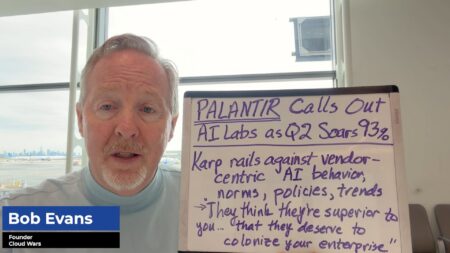
Palantir’s record growth underscores Alex Karp’s belief that customer-controlled AI will produce better business outcomes than today’s dominant technology models.

AI innovation is shifting from occasional product launches to continuous improvement, requiring business leaders to focus on workflows, experimentation, and human expertise rather than simply adopting the newest AI models.

SAP delivered 24% cloud revenue growth in Q2 while expanding its cloud backlog to $26.3 billion, with CEO Christian Klein crediting the company’s global partner ecosystem and AI strategy for accelerating customer adoption and positioning SAP for $30 billion in cloud revenue next year.

SAP is approaching a potential $30 billion cloud business as its partner-led strategy continues to outpace traditional enterprise software competitors.

Microsoft’s investment in Databricks reflects a broader strategy to strengthen every layer of the enterprise AI stack—from infrastructure and data platforms to intelligent business applications.

Customers will be able to capitalize on data from ZoomInfo, Dun & Bradstreet, Gong, and others in the flow of their Dynamics 365 sales processes.

AWS is expanding Security Hub with AI-specific protections and Azure support to secure AI and multicloud environments from a single platform.

Purview, Defender, and Graph API are all being enhanced to bring agents running on end-user devices under unified governance ‘control plane.’