


Multi-cloud partnerships reveal a deeper divide in cloud leadership, where Oracle’s early moves enabled seamless cross-platform deployment, leaving AWS positioned as a delayed follower.
Multi-cloud partnerships reveal a deeper divide in cloud leadership, where Oracle’s early moves enabled seamless cross-platform deployment, leaving AWS positioned as a delayed follower.

Latest MCP product from Microsoft works with cloud or on-premises SQL databases for efficient, secure connections to corporate resources without requiring language or framework expertise.

Despite Microsoft and AWS dominating in scale, Google Cloud’s Q4 performance suggests it may be capturing a disproportionate share of new enterprise cloud and AI workloads.
Round of enhancements also includes simplified prompting during agent-building processes, new content moderation controls to govern sensitive material.

Microsoft’s $10 billion Japan investment underscores a strategy combining AI infrastructure, workforce development, and data sovereignty to drive global growth while meeting increasingly strict regional compliance requirements.
With new agentic AI capabilities, Oracle eliminates the need for complex data pipelines, enabling faster development and deployment of AI applications while maintaining enterprise-grade security and scalability.

With its AI-first strategy, Oracle is transforming its database into an intelligent decision-making engine, enabling customers to activate data and gain a major competitive edge.
Google Cloud showcased its cybersecurity strategy at RSAC 2026, highlighting its Wiz acquisition and new agentic AI tools designed to automate threat detection, improve response times, and strengthen multicloud security in an increasingly complex digital landscape.

SAP makes moves to acquire Reltio, expanding customer access to AI-ready data from both SAP and non-SAP systems.
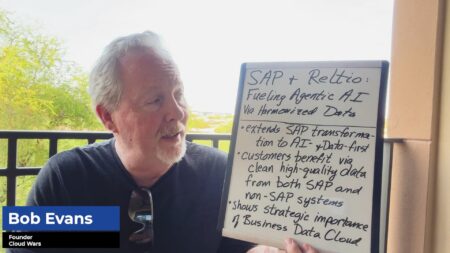
SAP takes another step toward being an AI-first, data-first company by acquiring Reltio, enhancing the Business Data Cloud and providing customers with access to quality data.
Google Cloud and Baker Hughes have partnered to tackle the massive energy demands of AI data centers, combining industrial power expertise with advanced AI to improve efficiency, sustainability, and reliability in global digital infrastructure.

The surge in AI data center demand is collapsing industry lines, pushing tech companies into energy partnerships that could redefine power generation, infrastructure investment, and long-term innovation strategies.
New AI-powered applications enable users to instruct systems with goals instead of processes, dramatically changing enterprise workflows and decision-making.
A unified, end-to-end approach is replacing fragmented healthcare systems with connected data and intelligent workflows powered by modern infrastructure.
Agentforce Contact Center represents Salesforce’s next evolution in customer service, merging voice, digital channels, and AI into one system. It empowers autonomous AI agents while ensuring human operators receive full interaction context for faster issue resolution.

Oracle and Microsoft’s once-unthinkable partnership has become a mainstream “multi-cloud miracle,” unlocking faster innovation, improved security, and simpler architectures while reshaping how competitors collaborate for customer success.
Multi-cloud databases are enabling faster AI adoption by bringing enterprise data closer to cloud-native tools and services.

Massive Google Cloud customer use cases and the emergence of patient agency supported by AI are early highlights of HIMSS 2026, according to healthcare tech exec Paul Swider.

Google Cloud and CVS Health launch Health 100, an AI-driven platform unifying patient data and enabling agentic healthcare workflows, signaling a major shift toward personalized, interoperable healthcare ecosystems.

The Cloud Wars Growth Chart shows extraordinary expansion across leading vendors as AI services drive demand. Palantir’s 70% growth leads the pack, while Google Cloud and Oracle also post dramatic gains.