

Oracle delivers a blowout Q1 as cloud infrastructure revenue surges 121% and its $664 billion RPO nearly matches Microsoft’s massive backlog.
Oracle delivers a blowout Q1 as cloud infrastructure revenue surges 121% and its $664 billion RPO nearly matches Microsoft’s massive backlog.
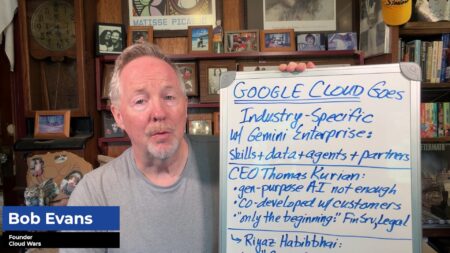
Google Cloud is taking Gemini Enterprise deep into vertical industries, beginning with financial services and legal and combining skills, data, agents, and partners into one AI system.

Instead of searching across laboratory results, medications, and specialist documentation, clinicians can prompt Epic and receive required information inside ChatGPT using new OpenAI connector.

Microsoft’s strategic collaboration with Saudi AI company HUMAIN demonstrates how localized language models could become central to enterprise AI adoption across the Middle East and Africa.
Since returning as CEO, Aneel Bhusri has reshaped Workday’s agentic AI strategy, eliminating or combining simpler agents while prioritizing sophisticated AI systems capable of solving complex HR and finance problems and delivering measurable customer ROI.

Workday is betting that fewer, more capable AI agents connected across enterprise systems and data will create greater customer value and differentiate it from larger rivals.

Meta’s massive Azure spending shows how AI is reshaping tech competition, with rivals increasingly becoming customers as infrastructure emerges as the new battleground.

OpenAI once prominently promoted an AI super app, but its disappearance from Sarah Friar’s latest strategic update raises questions about whether the concept has quietly become vaporware.

ServiceNow is rapidly building its cybersecurity presence, and three recent developments suggest Bill McDermott may see security as the company’s defining long-term opportunity.

Salesforce and Anthropic’s new ClaudeForce partnership could unlock enormous value trapped inside enterprise systems and redefine the future of AI-powered business applications.
Workday CEO Aneel Bhusri is increasingly bullish as rapid AI adoption, strong revenue growth, trusted enterprise context, and faster innovation strengthen Workday’s competitive advantage.

With AI run rate approaching $600 million and 5,500 customers using AI solutions, Workday is seeing powerful early evidence that its AI strategy is gaining traction.

New features enhance positioning of Teams as a platform to support humans, agents working together to accelerate GitHub-powered dev projects.

Microsoft, Salesforce, and UiPath are taking different approaches to free developer AI capacity as consumption emerges as an increasingly important metric for the enterprise technology industry.
Google Cloud and Mahindra are bringing Gemini Enterprise directly into vehicles, demonstrating how AI is moving beyond traditional digital environments and becoming embedded in physical-world endpoints.

AI monetization is moving upstream as rising agentic development costs push Microsoft and other vendors to charge builders for creating, testing, and executing AI-powered products.

Marc Benioff’s Salesforce is betting that combining Anthropic’s AI momentum with its massive enterprise presence can unlock new opportunities for customers and accelerate its AI strategy.
AI tokens are getting dramatically cheaper, but agentic reasoning is consuming far more of them, creating a surprising new challenge for enterprise AI economics.

AI security is becoming an ecosystem problem, and Workday is joining forces with major technology companies to share knowledge and strengthen protections across enterprise AI.

Google Cloud’s Gemini models are coming to Oracle applications, including Oracle AI Agent Studio for Fusion Applications, giving customers more flexibility to select models while turning AI reasoning into governed workflows, approvals, transactions, and business actions.