
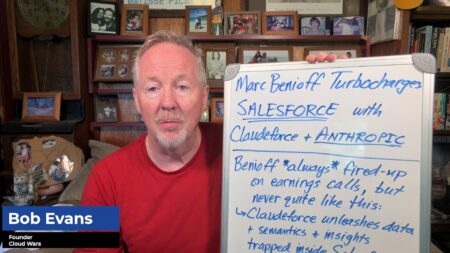
Salesforce and Anthropic’s new ClaudeForce partnership could unlock enormous value trapped inside enterprise systems and redefine the future of AI-powered business applications.
Salesforce and Anthropic’s new ClaudeForce partnership could unlock enormous value trapped inside enterprise systems and redefine the future of AI-powered business applications.
Workday CEO Aneel Bhusri is increasingly bullish as rapid AI adoption, strong revenue growth, trusted enterprise context, and faster innovation strengthen Workday’s competitive advantage.

On the strength of customer design partnerships and an expansive ecosystem, Google Cloud delivers AI platforms that could unlock AI innovation in support of vertical use cases.

With AI run rate approaching $600 million and 5,500 customers using AI solutions, Workday is seeing powerful early evidence that its AI strategy is gaining traction.

The launch of ChatGPT for Teens highlights a broader shift in AI competition, as technology companies increasingly compete not only on model capabilities but also on trust, safety, education and their ability to build lifelong user relationships.

New features enhance positioning of Teams as a platform to support humans, agents working together to accelerate GitHub-powered dev projects.
Microsoft, Salesforce, and UiPath are taking different approaches to free developer AI capacity as consumption emerges as an increasingly important metric for the enterprise technology industry.
Salesforce’s Q2 growth slowed to 11%, but a major Anthropic partnership and the launch of Claudeforce could boost future growth and validate Marc Benioff’s AI ambitions.
AI monetization is moving upstream as rising agentic development costs push Microsoft and other vendors to charge builders for creating, testing, and executing AI-powered products.

Marc Benioff’s Salesforce is betting that combining Anthropic’s AI momentum with its massive enterprise presence can unlock new opportunities for customers and accelerate its AI strategy.
AI tokens are getting dramatically cheaper, but agentic reasoning is consuming far more of them, creating a surprising new challenge for enterprise AI economics.
AI security is becoming an ecosystem problem, and Workday is joining forces with major technology companies to share knowledge and strengthen protections across enterprise AI.

Google Cloud’s Gemini models are coming to Oracle applications, including Oracle AI Agent Studio for Fusion Applications, giving customers more flexibility to select models while turning AI reasoning into governed workflows, approvals, transactions, and business actions.

Gmail, Calendar, and Drive users can now access data and perform tasks directly from their Claude conversations, accelerating integration of AI tools and productivity tools.
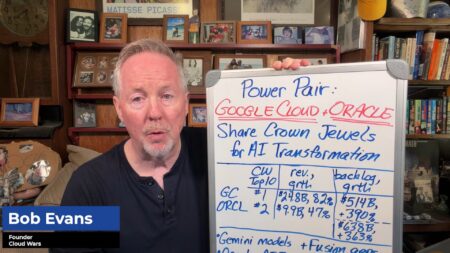
Google Cloud and Oracle are emerging as an AI power pair, combining Gemini, Fusion applications, and Oracle AI Database to help customers accelerate enterprise AI transformation.

Microsoft is reportedly tightening controls on internal AI token consumption, urging employees to choose models based on tasks and focus on business outcomes. The shift highlights growing enterprise pressure to balance AI performance with rapidly expanding infrastructure costs.

Consolidated AI chatbots raise order values up to 26% at Albertsons, while WalMart’s in-store AI use requires employees to further train AI models with business context.
After proving its custom silicon strategy with Maia 200, Microsoft is preparing a much larger Maia 300 push designed to support both AI training and inference.
ServiceNow adds six agentic security offerings designed to automate threat detection, governance, compliance, and remediation.
Google Cloud’s infrastructure strategy gives frontier AI lab Mirendil the flexibility and scale needed to speed up the AI research loop.