

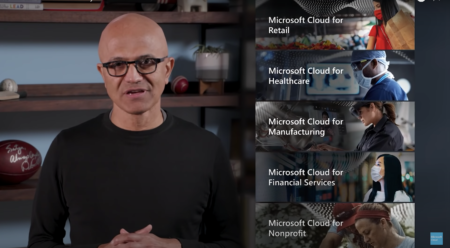
Late last month, Nadella declared that the world’s #1 cloud vendor will intensify its “industry-first focus.”
Late last month, Nadella declared that the world’s #1 cloud vendor will intensify its “industry-first focus.”

Snowflake continued on its high-growth trajectory in Q4, with cloud revenue jumping 116% to $178M and overall revenue soaring 117% to $190M.

On this Cloud Wars Live podcast, Christian Anschuetz talks about how bold, courageous leadership can keep biz off the path of extinction.

As things in every industry are changing incredibly fast, all leaders can learn from the outlook McDermott cultivates inside ServiceNow.

Bhusri said CFOs who’ve battled thru the pandemic with inflexible on-prem systems are on the verge of committing fully to the cloud.
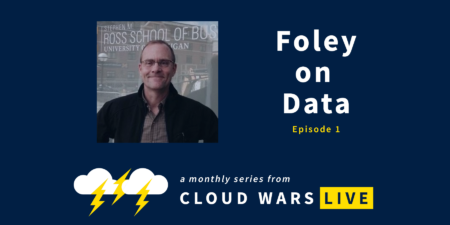
On this Cloud Wars Live podcast, Sean Ammirati and I discuss transformational business practices and how data can be a revenue maximizer.

I’m puzzled by 3 comments Marc Benioff made on Salesforce’s recent Q4 earnings call. Read more from Cloud Wars.
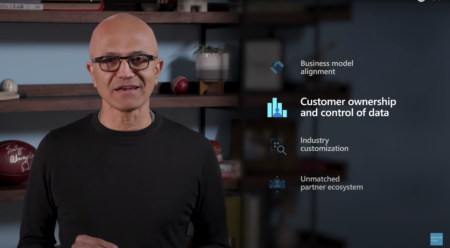
The Microsoft leader clearly alluded to AWS when he said cloud providers that compete with customers in other biz will never establish trust.

Serving as a Validation Accelerator, each of these DAC @Work Case Studies analyzes the impact, metrics, and outcomes of your solution by analyzing a real-world customer implementation.
Discover the latest @Work Case Study Monthly Round-Up!
On the Cloud Wars Live podcast, Bonnie Tinder offers advice around exec communication, from delivering the good news first to K.I.S.S.

In this blog by Pablo Moreno, we reflect on the growing implementation of digital transformation in the workplace and how we (might) see it evolve in the future.
With hundreds of thousands of companies surging into the cloud and aspiring to be a data-driven business, cloud databases are…

Award-winning journalist John Foley has created the Cloud Database Report, new from Cloud Wars. Stream my latest conversation with John.

In the Cloud Database Report, contributing editor John Foley describes the enormous upheaval & potential in this rapidly growing market.

Looking at ways to better meet the needs of your clients is critical for accountants. Using customer relationship management software (CRM) is an excellent way to serve your clients by keeping them happy and engaged. CRM software is also simple to use, allowing accountants to work much more efficiently without constantly dealing with technical issues.

Low-code/no-code isn’t just the hottest buzzword/term now, but a major technology category with huge growth potential in this decade. In part 1 of this series, I explore the evolution of low-code/no-code, call out a few players in the space, and leave you with tips to consider before choosing a solution.Source info:Intrado: https://www.globenewswire.com/news-release/2020/11/10/2123468/0/en/Global-187-Billion-Low-Code-Development-Platform-Market-to-2030.html#:~:text=The%20global%20low%2Dcode%20development,period%20(2020%2D2030). Excel history: https://microsoft.fandom.com/wiki/Microsoft_Excel SAP Purchases Appgyver: https://news.sap.com/2021/02/sap-acquire-appgyver/ John’s take on Appgyver: https://mydacfeed.com/view/video/sap-acquires-no-code-platform-appgyver App references:Retool: https://retool.com/Bubble: https://bubble.io/Excel: https://www.microsoft.com/en-us/microsoft-365/excelWordpress: https://wordpress.com/ Microsoft Power Apps: https://powerapps.microsoft.com/ AWS Honeycode: https://www.honeycode.aws/ Google Appsheet: https://www.appsheet.com/ AppGyver: https://www.appgyver.com/

On the Cloud Wars Live podcast, Tony Uphoff and I discuss a few remarkable data trends related to the rapidly transforming auto industry.

Microsoft has reported that that its “remaining performance obligation” (RPO) for cloud reached a total of $112 billion, up 24%.
Gartner: 75% of all databases will be deployed or migrated to a cloud platform by 2022. Subscribe to the new Cloud Database Report.

There’s an intriguing debate in the data analyst community on whether Excel or Power BI is the best tool for data analysis.
Hear Pablo Moreno’s perspective: he believes it’s not about the tool, but rather, your data needs – data ingestion, data size, data aggregation, distribution of the information.