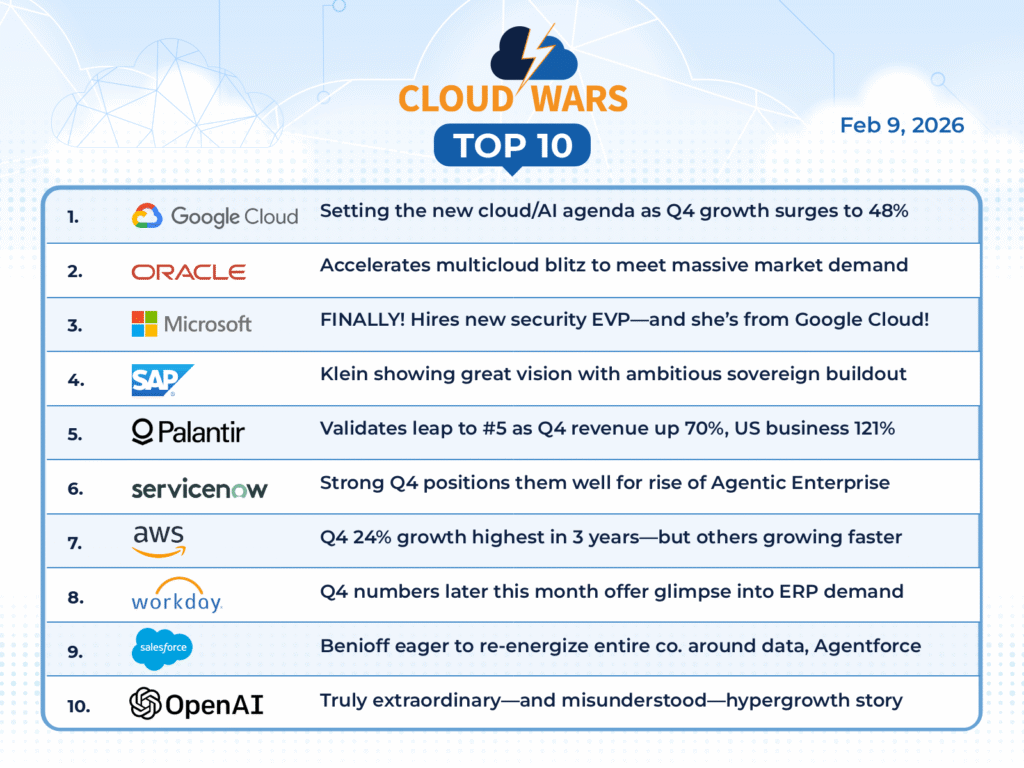




While Microsoft continues to be the largest cloud and AI vendor by far, both Google Cloud and AWS outperformed Microsoft in a key Q4 growth metric, underscoring profound changes in customer preference and validating my recent downgrade of Microsoft from #1 to #3 on my Cloud Wars Top 10.
To be clear, I’m fully aware that when it comes to sheer size, there is no question whatsoever that Microsoft is the world’s largest cloud and AI player as its quarterly cloud revenue for the period ended Dec. 31 was $51.5 billion, which is almost more than the combined comparable revenue figures for Google Cloud, $17.7 billion, and AWS, $35.6 billion.
At the same time, it’s equally true that each of those numbers generally reflect contracts signed one or two or even three years ago — and that’s perfectly fine. But with the global economy changing and evolving at an extraordinary rate, and with hyperscaler technology playing an increasingly vital role in laying the foundations for the global AI Economy, the revenue figures that matter most are those that are most-recent and reflect where things are headed rather than where they’ve been.

AI Agent & Copilot Summit is an AI-first event to define opportunities, impact, and outcomes with Microsoft Copilot and agents. Building on its 2025 success, the 2026 event takes place March 17-19 in San Diego. Get more details.
So to identify who’s hot in the here and now, let’s see how much incremental revenue each company generated from calendar Q3 to calendar Q4:
| Company | Q4 Revenue | Q3 Revenue | Incremental Revenue |
|---|---|---|---|
| Microsoft | $51.5B | $49.1B | $2.4B |
| AWS | $35.6B | $33.0B | $2.6B |
| Google Cloud | $17.7B | $15.2B | $2.5B |
**Microsoft’s fiscal year runs July 1 to June 30.
Well, well, well — look at that! I would have thought that since Microsoft’s calendar Q4 cloud revenue of $51.5 billion is 45% larger than AWS’s $35.6 billion, then Microsoft should have generated much more Q4-over-Q3 incremental cloud revenue than AWS. But — in reality, AWS outperformed Microsoft Cloud on that count by $200 million: $2.6 billion to $2.4 billion. Was it just a great quarter for AWS? Or a stumble by Microsoft? Or both?
But even more striking to me is that Google Cloud also outperformed Microsoft on Q4-over-Q3 cloud revenue as well. After all, Microsoft’s total cloud revenue of $51.5 for the quarter was almost 3X bigger than Google Cloud’s $17.7 billion, so it would have been perfectly reasonable to expect Microsoft Cloud to thoroughly trounce Google Cloud in new incremental revenue. But in fact Google Cloud’s $2.5 billion topped Microsoft’s $2.4 billion.
Now, it is possible that this is a single-quarter fluke, and that Google Cloud’s stunning 48% Q4 growth rate was simply an anomaly, and that its superiority over Microsoft Cloud was a blip and mighty Microsoft will put the world back on its axis next quarter.
But I would strongly caution against such an interpretation.
Because Google Cloud’s emergence and outsized growth numbers are most certainly not an aberration. This comparison of quarterly growth rates across 2025 (starting with Q4) shows that while Microsoft’s growth rates have been relatively flat, AWS’s have gone up nicely while Google Cloud’s have spiked:
- Google Cloud: 48%, 34%, 32%, 28%
- Microsoft: 26%, 26%, 27%, 20%
- AWS: 24%, 20%, 17.5%, 17%
Final Thought
As I’ve said many times regarding the metrics I use for my Cloud Wars Top 10 rankings, size certainly matters — but it is by no means the only thing. Growth rates are a huge factor because they’re a direct reflection of customer demand. In a market stuffed with world-class vendors, which ones — right here and now, not a year or two ago — are winning outsized shares of customers’ hearts, minds, and wallets?
Microsoft’s the biggest — no doubt. But the numbers above show that at least for now, it’s certainly not the hottest in the minds of the only people whose opinion really matters: the customers.