



Microsoft and more than 20 tech companies urge U.S. lawmakers to protect open-weight AI models, arguing openness drives innovation and competition.

Microsoft and more than 20 tech companies urge U.S. lawmakers to protect open-weight AI models, arguing openness drives innovation and competition.

Palantir’s Q2 2026 results reveal 93% growth, a bold AI sovereignty strategy, and how its customer-first approach is reshaping enterprise AI.

Data breaches hit hardest in healthcare and financial services, while the firms that tap AI most aggressively are focusing on hunting threats and automating attack responses.
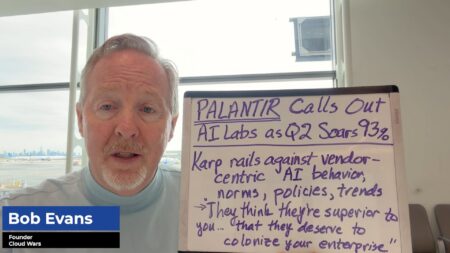
Palantir’s record growth underscores Alex Karp’s belief that customer-controlled AI will produce better business outcomes than today’s dominant technology models.

Nadella believes enterprises should have the freedom to choose AI providers, privately train models, manage costs, and retain complete control over their accumulated organizational intelligence.

Businesses can unlock greater AI value by understanding when to use chat assistants, coding agents, co-work agents, or custom workflows.

AWS delivered its strongest quarter in years, posting 37% revenue growth, a 154% backlog increase, and $42.2 billion in revenue while overtaking Microsoft in growth and strengthening its AI leadership.

AI innovation is shifting from occasional product launches to continuous improvement, requiring business leaders to focus on workflows, experimentation, and human expertise rather than simply adopting the newest AI models.

Project Perception scales vulnerability discovery for today’s AI-powered threats. Initially available in Defender, Perception will extend across the company’s security lineup.

Microsoft’s investment in Databricks reflects a broader strategy to strengthen every layer of the enterprise AI stack—from infrastructure and data platforms to intelligent business applications.

A screenless AI companion from OpenAI could redefine smart home technology by combining conversational AI with contextual awareness and adaptive personalization.

While Microsoft generated $59.3 billion in quarterly cloud revenue, Google Cloud’s much faster growth suggests the AI revolution is rapidly reshaping the competitive landscape.

Users can securely connect information from Apple Health and supported medical records for detailed personal medical insights.

During a conversation with Bob Evans, Oracle EVP Chris Leone outlined how Fusion Agentic Applications automate business processes using teams of AI agents, enabling organizations to improve productivity while executing work directly inside Oracle’s system of record.

Microsoft’s partnership with 3M demonstrates that the next competitive frontier in AI infrastructure extends well beyond GPUs, with networking and optical connectivity emerging as critical strategic differentiators.

Microsoft says AI sovereignty is about maintaining national control while embracing the world’s best AI technologies, rather than isolating countries from global innovation.

Ahead of Microsoft and AWS earnings, Google Cloud has established a commanding growth advantage, with revenue increasing 82% and backlog soaring 390%, signaling strong customer confidence and significant future revenue opportunities.

Customers will be able to capitalize on data from ZoomInfo, Dun & Bradstreet, Gong, and others in the flow of their Dynamics 365 sales processes.

Alphabet is embracing massive AI infrastructure investments despite investor backlash, betting that today’s spending will secure tomorrow’s cloud leadership.

An analysis of how Oracle is helping enterprises prepare their data infrastructure for large-scale agentic AI deployments.