



The wild imbalance between Oracle’s $664 billion backlog of future revenue and its $46 billion annualized cloud and AI business is beginning to come into a geocentric phase as its otherworldly RPO total has started to convert into cold, hard cash, as personified by Q1’s 121% jump in cloud infrastructure revenue.
While Oracle is by far the smallest of the four hyperscalers, it has now become the second-fastest growing as this comparison of most recent quarterly results shows:
- Google Cloud 82% to $24.8 billion
- Oracle 62% to $11.6 billion
- AWS 37% to $42.2 billion
- Microsoft 27% to $59.3 billion
But, inside that label of “second-fastest growing” are the two key reasons for my bullishness on Oracle’s future:
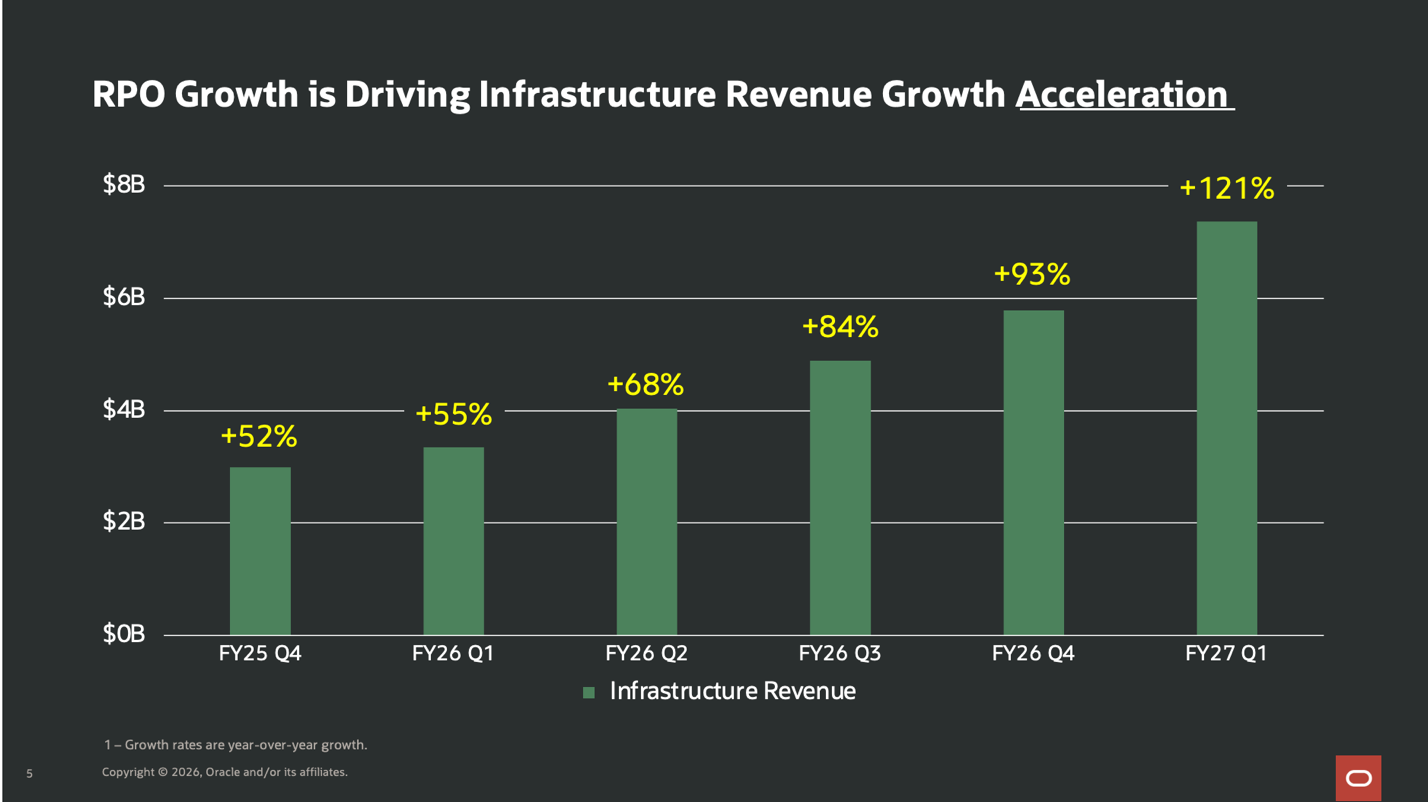
- While overall Q1 cloud revenue was up 62%, the Oracle Cloud Infrastructure portion of that total soared 121% to $7.5 billion; and
- Oracle’s RPO total jumped 46% for the quarter to $664 billion, meaning that the pipeline for future OCI revenue is enormous — and, in fact, is larger than the backlog totals for AWS ($496 billion) and Google Cloud ($514 billion), and almost as large as the RPO/backlog for Microsoft ($678 billion).
In that context, this slide from Oracle’s fiscal-Q1 release last week shows the explosive and rapidly accelerating customer demand for OCI over the past six quarters. When we also consider that Oracle boosted its Q1 RPO by 46% to the $664 billion mentioned above, we can see that it the up-and-to-the-right trend captured in this graphic is likely to maintain that dazzling trajectory well into the future.
On the Q1 earnings call, Oracle CEO Clay Magouyrk answered numerous questions about the correspondingly huge requirement for capital to fund the buildout of AI data centers to meet all that future demand, and I want to emphasize that Magouyrk’s responses had as much to do with innovative business models and go-to-market plans as with breakthrough technology and rigorous operational expertise.
“OCI continues to grow quickly by delivering the capacity our customers need,” Magouyrk said in making something that’s extremely complex sound disarmingly simple.
But, pay attention to some of the figures he then shared.
In Q1 ended Aug. 31, Magouyrk said, “We delivered 850MW of AI capacity, containing more than 300,000 GPUs to customers. So, delivery in Q1 is almost three times what we delivered in all of Q4, and 73% of the total capacity we delivered last fiscal year.”
Those results show that what Magouyrk has been talking about publicly for the past few years is coming true: to be able to not only meet customer demand but also remain faster and nimbler than its much larger hyperscaler competitors, Oracle has had to become a master builder of not just databases and apps and agents but also some of the world’s largest buildings.
“This reflects years of investment in every aspect of infrastructure, from data center design through supply chain and manufacturing to installation and operations,” Magouyrk said before delivering the customer-centric punchline.
“Customer demand continues to support this investment. We closed more than $30 billion of additional AI contracts in Q1 without requiring additional capital from Oracle.”
Wait a minute — how can that be? How could Oracle close “more than $30 billion in additional AI contracts in Q1 without requiring additional capital from Oracle?”
That’s where the magic of business model innovation meets and complements all the technological and logistical innovation Oracle has been pouring into its data center buildouts.
“For the past several quarters, I think you’ve heard us talking about the need to be constantly finding interesting ways to fund the business,” Magouyrk said.
“And one of the mechanisms that we have to fund our business is obviously that we go out and we spend our own capital, but we’ve also invested very heavily in relationships with different suppliers and vendors, and we’ve invented new business models, including ‘bring your own hardware,’ all of which have different ways of spreading out that capital,” he said.
“So, we have to separate out in our minds what Oracle spends as CapEx directly, and uncouple that from how we think about how the business can grow. Because from our perspective, I think we see ways that while capital is still required to do this work, it doesn’t all have to flow from the Oracle side — it doesn’t all have to be Oracle CapEx.”
A bit later in the call, in response to another question about where this capital will come from if it is not Oracle CapEx, Magouyrk offered some additional details.
“Sometimes it’s working with our suppliers through different financing arrangements that allows us to pay for the capacity as the customers pay us — that’s one mechanism,” Magouyrk said.
“Another mechanism is that a customer says, ‘I’d like to pay for the hardware but use your operational ability and your cloud-infrastructure technology assets and your data center to go out and actually turn that into an AI cluster.’
“A third option is that the customer has been able to raise money — maybe it’s a startup, maybe it’s an established company — and says, ‘I would like to pay you up front as a prepayment,’ and so that doesn’t require us to front the cash to go out and spend those dollars on that capital expenditure,” he said.
“So, we have different models for achieving that goal. In terms of the types of customers and, and where we see that demand, it’s really broad-based — it doesn’t matter if it’s a startup or the most-valuable investment-grade companies.
“There’s an understanding of this model right now that the access to capital and different ways of funding it are a constraint.
“And the industry adapts to allocate that in the most efficient way possible.”
Final thought
Magouyrk’s description of how everyone involved — Oracle’s suppliers, Oracle itself, and Oracle’s customers — is displaying great flexibility to achieve their desired ends underscores how the Cloud Wars of mid-2026 are as much about go-to-market and business model innovation as they are about technology.
And that’s a key reason why my decision early this year to move Oracle into the #2 spot on the Cloud Wars Top 10 is playing out the way it is in the marketplace today: because what got us here will surely not get us there.