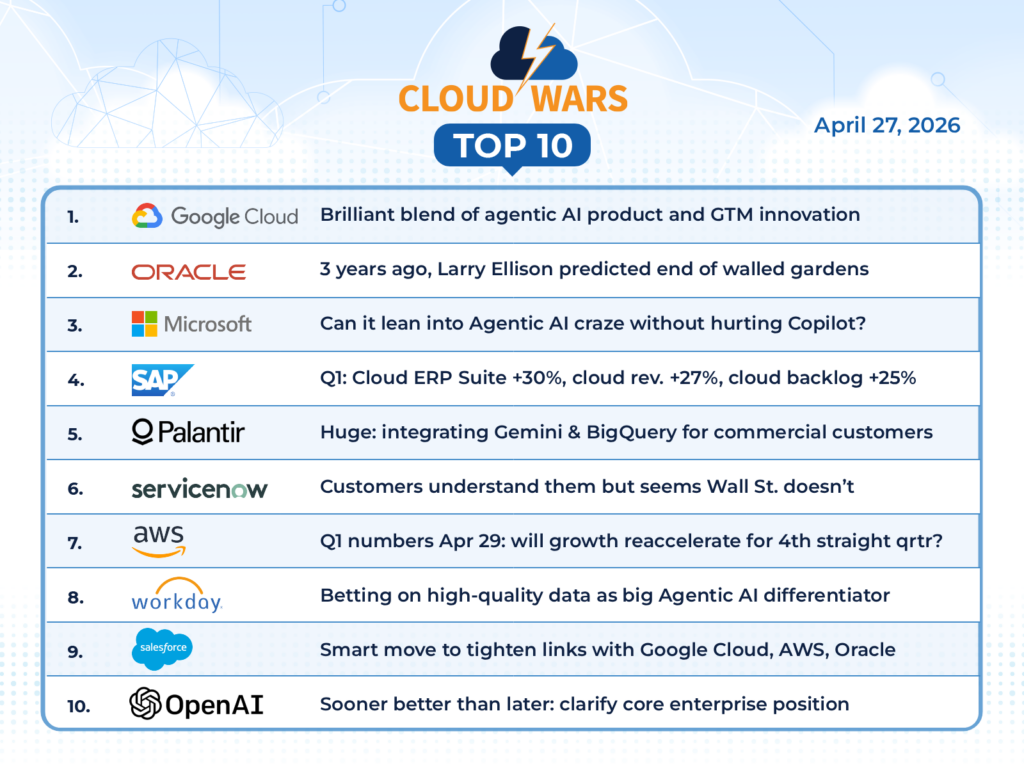



If the SaaS industry that runs the world economy is headed for an apocalyptic hell, then how did SAP’s Q1 cloud revenue manage to grow 27% to $7 billion?
If the ascent of AI is triggering an inevitable Armageddon for incumbent applications vendors, then why did SAP’s current cloud backlog grow 25% in Q1?
If data is the essential and indispensable fuel for the Agentic Revolution, then why is SAP — keeper of a vast portion of the world’s business data — being measured for a coffin?
Now, I’m fully aware I’m not the brightest guy in the world, but I’m increasingly puzzled by the wild disparities we’re all seeing between (a) the dire forecasts of doom for the enterprise-apps business and (b) the ongoing strong performances of these allegedly don’t-even-know-they’re-dead-yet companies.
Since the Q1 numbers SAP released late last week offer a perfect example of this stark disconnect, let’s take a quick look at a few of SAP’s key results for the quarter ended March 31:
- Cloud revenue up 27% to $6.98 billion;
- Within that, Cloud ERP Suite revenue up 30% to $6.1 billion; and
- current cloud backlog up 25% to $25.7 billion.
If those numbers are evidence of an imminent AI-engineered apocalyptic demise, then somebody please explain to me the new diagnostics of decline. Because I think most reasonable people would look at those numbers and say they’re pretty darn impressive.
Community Summit North America
The largest independent innovation, education, and training event for Microsoft business applications delivered by Expert Users, Microsoft Leaders, MVPs, and Partners.
Register
During an interview with cnbc.com, SAP CEO Christian Klein wisely chose not to accept the premise of some looming Armageddon and instead focused on both SAP’s ability to meet the needs of its AI-obsessed customers and also SAP’s unmatched data assets.
“SAP is uniquely positioned to win in Business AI, and I would definitely say that not every software company should be treated in the same way,” Klein told cnbc.com.
“In SAP’s ERP, all the customers are storing their most mission-critical domain know-how about their business processes and their business data. And this is exactly what the AI agents need: they need to have this context on how to run businesses in order to take actions. 90% accuracy is not enough when you are actually giving AI agents control over your payroll or your financial close or your supply chain.”
Contrary to the investment community’s fixation on forecasting doom and destruction for providers of enterprise apps, Klein said that the strong growth SAP expects for not only 2026 but also into next year will enable the company the ability to continue investing aggressively in not only its AI-centered innovation but also its people.
“Look at our growth: the pipeline for 2026 is very healthy and we are re-investing first of all into the skills of our people,” Klein told cnbc.com. “In order to apply AI at scale, every company needs to upskill the workforce and give them the skills they need.
“Second, with such a pipeline like what we are having and such a roadmap on AI, we’re going to double down and are re-investing all this money to innovation and really making sure that we can acclerate our growth because what our customers want is, ‘Hey, we want to have more AI agents for our supply chain, for our finance, for our HR business, and this is what we are doing.”
Klein’s not dishing out unsubstantiated fluff here — he’s talking about very impressive category-leading numbers that SAP has been pumping out for the past 10-12 quarters. And since it is absolutely impossible that the Chicken Little crowd would be unaware of SAP’s sustained record of outstanding growth in both revenue and pipeline, I can only conclude that the doomsayers think that SAP and other enterprise-apps providers haven’t heard about agentic AI or believe that it is the future.
Final Thought
And that outlook was anticipated almost 200 years ago by Charles Dickens in the person of his odious character, Bumble the Beadle, whose comment about British law way back then perfectly sums up my feelings about the nonsense the Chicken Little crowd is spewing:
“If the law supposes that, then the law is a ass — an idiot. If that’s the eye of the law, the law’s a bachelor; and the worst I wish the law is, that his eye may be opened by experience — by experience.”