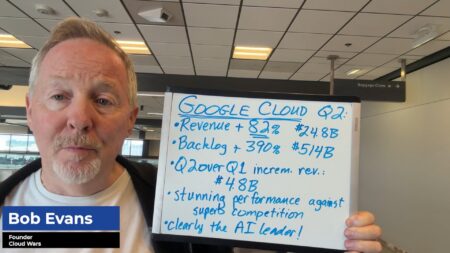


Google Cloud’s Q2 revenue reached $24.8 billion, up $4.8 billion sequentially. Microsoft Cloud also added $4.8 billion, while AWS added $4.6 billion, suggesting remarkably close competition for incremental customer spending among the three hyperscalers.

revenue
Google Cloud delivered standout Q2 momentum, adding as much new quarterly revenue as Microsoft and more than AWS despite operating from a significantly smaller revenue base.
AWS delivered its strongest quarter in years, posting 37% revenue growth, a 154% backlog increase, and $42.2 billion in revenue while overtaking Microsoft in growth and strengthening its AI leadership.
SAP delivered 24% cloud revenue growth in Q2 while expanding its cloud backlog to $26.3 billion, with CEO Christian Klein crediting the company’s global partner ecosystem and AI strategy for accelerating customer adoption and positioning SAP for $30 billion in cloud revenue next year.
Google Cloud’s $4.8 billion sequential revenue increase establishes a new benchmark for Microsoft Cloud and AWS as investors prepare for their upcoming earnings reports.
Explosive Q2 results suggest Google Cloud is outperforming rivals where it matters most—winning new AI business and accelerating faster than Microsoft Cloud and AWS.
AWS and Microsoft are taking radically different branding approaches to AI deployment, raising questions about which strategy enterprise customers will embrace.
OpenAI’s enterprise business is emerging as the company’s primary growth engine, already accounting for 40% of revenue and expected to reach 50% by the end of 2026, according to CRO Denise Dresser.
Returning CEO Aneel Bhusri says technology transitions require companies to make emerging technologies their absolute top priority.
Google Cloud’s explosive Q1 growth and backlog dominance highlight a major shift in cloud leadership, overtaking AWS as AI-driven demand reshapes competitive dynamics among hyperscalers.
Multi-cloud partnerships reveal a deeper divide in cloud leadership, where Oracle’s early moves enabled seamless cross-platform deployment, leaving AWS positioned as a delayed follower.
Google Cloud is rapidly gaining momentum in the AI-driven cloud market, outpacing AWS and Microsoft in growth rates while reshaping competitive dynamics despite still trailing both rivals in total revenue scale.
SAP plans a gradual move from SaaS subscriptions to AI usage-based pricing, signaling a structural change in enterprise software economics.
OpenAI aims to scale revenue from $5B to potentially $280B by 2030, but a reported $800B cut in infrastructure spending raises questions about how compute-driven growth can sustain such aggressive enterprise expansion.
Rejecting “SaaSpocalypse” fears, Aneel Bhusri argues AI will enhance enterprise applications rather than replace them. Workday’s strategy focuses on AI agents embedded within its HR and finance platform to drive new growth and customer value.
Salesforce posts 12% Q4 revenue growth and 14% RPO growth, signaling a confident return to high-performance execution.
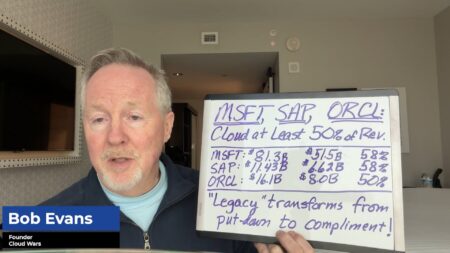
Legacy expertise in on-prem and cloud is emerging as a decisive advantage for Microsoft, SAP, and Oracle in the expanding AI economy.
Hyperscalers are facing soaring AI demand, with Microsoft, Oracle, AWS, and Google Cloud reporting a massive $1.63 trillion backlog in contracted business not yet recognized as revenue.
Google Cloud and AWS surpassed Microsoft in Q4 cloud revenue growth, signaling a shift in customer preference and prompting a downgrade of Microsoft to #3 in the Cloud Wars Top 10.
AWS posted its best quarter in years, yet still ranks third behind Google Cloud and Microsoft in growth momentum.