


Oracle recently unleashed new SaaS services and capabilities designed to make it easier and faster for customers to take full advantage of the cloud.
Oracle recently unleashed new SaaS services and capabilities designed to make it easier and faster for customers to take full advantage of the cloud.

SaaS industry will no longer support many hundreds or even thousands of boutique apps firms and will consolidate rapidly around a dozen or so top players.

Oracle is using “adaptive intelligence” capabilities for its entire NetSuite family of integrated applications aimed at small and mid-sized businesses.
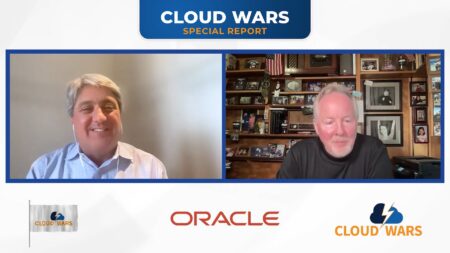
New AI-powered applications enable users to instruct systems with goals instead of processes, dramatically changing enterprise workflows and decision-making.
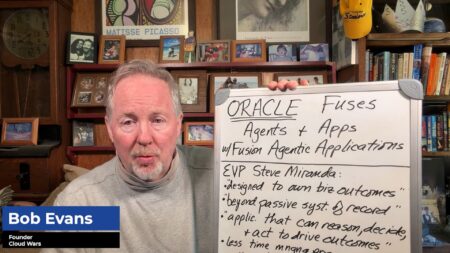
Steve Miranda outlines Oracle’s vision for agentic applications that don’t just assist — but actively drive business outcomes across sales, supply chain, and workforce operations.

Larry Ellison steps back on earnings calls as Mike Sicilia and Clay Magouyrk take the lead, signaling a deliberate and confident leadership transition at Oracle.
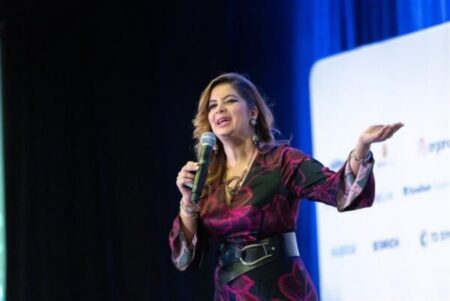
Dona Sarkar calls out the “tech bro”-driven AI hype machine and shares a blueprint to push AI into mainstream use cases that will deliver on the tech’s considerable promise.
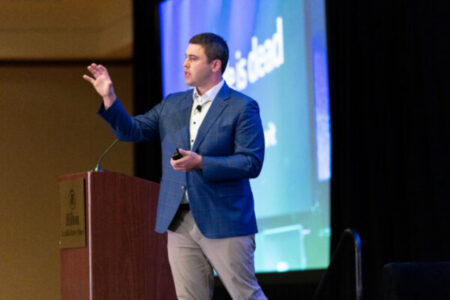
WorkIQ-powered Copilot Cowork orchestrates complex tasks to the point it could take over one-fifth of any team’s work in the near term, while hastening the end of app-powered work.

Rather than replacing SaaS, AI is becoming its most powerful accelerator. Oracle’s approach embeds agentic AI across Fusion applications, enabling faster deployments, reduced operational complexity, and dramatically improved customer outcomes.
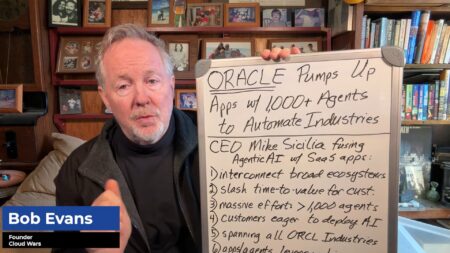
Oracle is rejecting the “end of SaaS” narrative, arguing that AI agents will dramatically expand the power and value of enterprise applications.
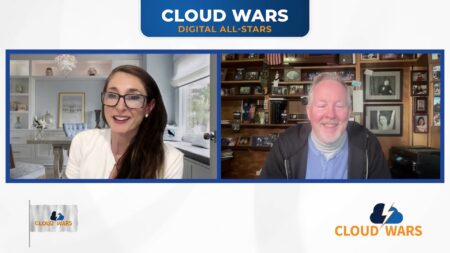
Organizations must balance AI experimentation with governance to prevent shadow AI projects from fragmenting data and creating new security risks.

Oracle’s fiscal Q3 could deliver massive cloud and RPO growth driven by AI demand, though it may still fall short of Google Cloud’s 48% hyperscaler growth benchmark.
Rejecting “SaaSpocalypse” fears, Aneel Bhusri argues AI will enhance enterprise applications rather than replace them. Workday’s strategy focuses on AI agents embedded within its HR and finance platform to drive new growth and customer value.
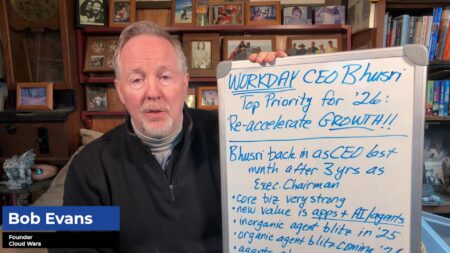
Workday is betting its future growth on blending AI agents with its existing HR and finance platforms, rejecting the notion that large language models alone can replace enterprise software.
Returning CEO Aneel Bhusri used Workday’s Q4 earnings call to dismantle claims that AI will replace ERP and HR systems, outlining instead a hybrid future where deterministic enterprise apps and probabilistic AI work together.

Security Dashboard for AI is built to rein in AI sprawl with Defender, Entra, and Purview integration as well as inventory functions that span Microsoft and widely used third-party AI software.

Healthcare leader weighs in on how AI models and mulit-cloud underpin customers’ mission-critical systems, and how they should prepare for potential model changes.
Workday cofounder Aneel Bhusri has returned as CEO following Carl Eschenbach’s departure, vowing to lead the company through what he calls its “most pivotal moment” as AI reshapes enterprise software and competitive dynamics.
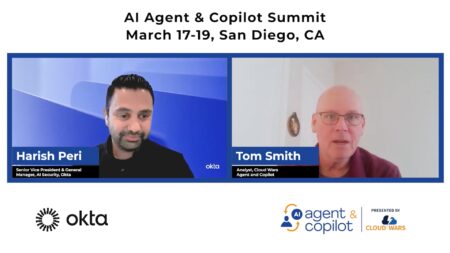
Cross App Access, being added as a core part of the MCP specification, allows centralized management of user entitlements, closing a gap that currently exists with some MCP servers.

Palantir is directly challenging ServiceNow’s claim as the premier AI platform, citing faster growth, greater deal volume, and more impactful AI delivery.