


Microsoft’s new Copilot Tasks signals a shift from AI chat to autonomous action, positioning Copilot as a personal assistant that can manage everyday tasks through natural-language commands.
Microsoft’s new Copilot Tasks signals a shift from AI chat to autonomous action, positioning Copilot as a personal assistant that can manage everyday tasks through natural-language commands.

New AI features deliver notable enhancements to five types of SharePoint content while the UX is refreshed and agentic AI strengthens governance.

Anthropic Claude-powered feature headlines Copilot Wave 3 announcement. Other enhancements include app-native Copilots and the Microsoft 365 E7 ‘Frontier Suite.’

ServiceNow introduces the Autonomous Workforce — AI specialists that work alongside humans to run enterprise workflows end-to-end.

Facing unprecedented pressure from customers navigating AI transformation, SAP, Oracle, and Workday are restructuring their sales organizations. Each company is simplifying customer engagement, flattening leadership structures, and aligning sales with services to deliver faster decisions and stronger outcomes.

OpenAI has secured $110 billion in funding from Amazon, NVIDIA, and SoftBank, valuing the company at $730 billion. The investment aims to expand global AI infrastructure, accelerate frontier model development, and scale enterprise and consumer AI adoption worldwide.
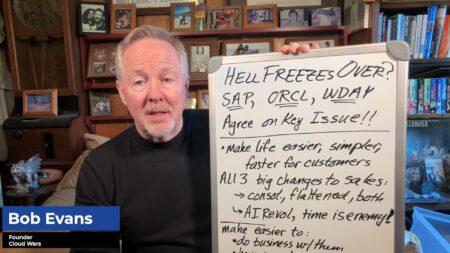
In a rare alignment, SAP, Oracle, and Workday are simplifying sales models to reduce complexity and accelerate digital transformation for customers navigating the AI revolution.

Oracle’s fiscal Q3 could deliver massive cloud and RPO growth driven by AI demand, though it may still fall short of Google Cloud’s 48% hyperscaler growth benchmark.
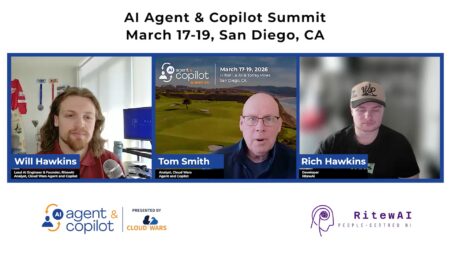
Framework lets users and developers bring their own models, supports both A2A and MCP for seamless integration of diverse AI tools, Will Hawkins and Rich Hawkins note.
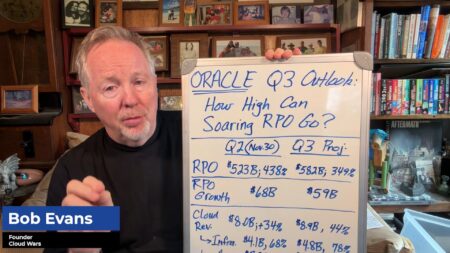
Oracle’s Q3 outlook reveals explosive growth in remaining performance obligations, suggesting the company’s AI training and infrastructure capabilities are driving enormous future demand beyond its OpenAI partnership.

As AI infrastructure demand surges toward a projected $4.3 trillion market, OpenAI recalibrates its spending timeline to balance investor confidence with continued aggressive investment in compute infrastructure.
Rejecting “SaaSpocalypse” fears, Aneel Bhusri argues AI will enhance enterprise applications rather than replace them. Workday’s strategy focuses on AI agents embedded within its HR and finance platform to drive new growth and customer value.

Monday’s outage impacting several Claude tools was relatively brief, but it highlights the integral role of AI in modern workflows and the need for robust continuity plans.
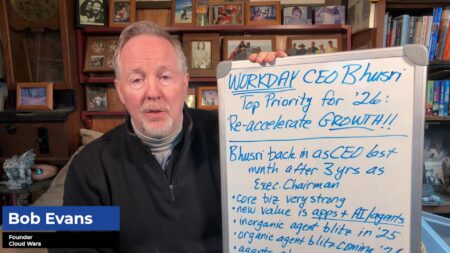
Workday is betting its future growth on blending AI agents with its existing HR and finance platforms, rejecting the notion that large language models alone can replace enterprise software.
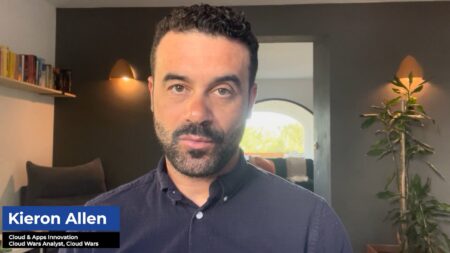
Financial services, manufacturing, and retail are leading AI agent implementation, demonstrating how operational use cases are driving measurable transformation across high-impact sectors worldwide.
Salesforce’s planned acquisition of Momentum strengthens its AI portfolio by integrating unstructured conversational data into Agentforce 360 and Slackbot, accelerating agentic workflows and delivering deeper customer insights for sales and go-to-market teams.
Microsoft expands Copilot with business-process agents, tuning templates, and standalone AI assistants designed to transform workflows across sales, finance, service, and enterprise productivity.
Salesforce delivered $41.5B in annual revenue and $11.2B in Q4, with Marc Benioff calling it one of the best performances in software history as AI offerings like Agentforce drive renewed growth momentum.
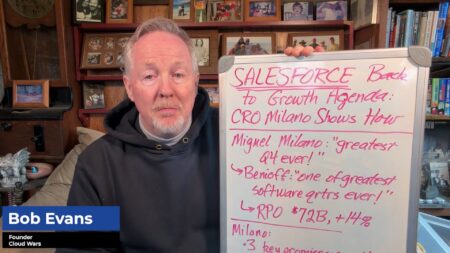
Salesforce posts 12% Q4 revenue growth and 14% RPO growth, signaling a confident return to high-performance execution.
Returning CEO Aneel Bhusri used Workday’s Q4 earnings call to dismantle claims that AI will replace ERP and HR systems, outlining instead a hybrid future where deterministic enterprise apps and probabilistic AI work together.