


While Palantir is still relatively small in the lofty enterprise-software firmament and is considered an oddball by traditionalists, its advanced technology, intensity of customer engagements, and passionate advocacy for customer outcomes could radically overhaul how the entire industry works.
That is, to be sure, an ambitious possibility, and it’s also one that Karp himself has not directly addressed. In fact, I suspect the refreshingly honest and blunt Karp would say that overall, he couldn’t care less what other software companies do or don’t do — after all, he and his company have been fully committed outsiders since the company was founded 23 years ago, and nothing Karp has said or done recently suggests that position’s about to change.
Rather, the premise of the question in the headline is rooted in the self-interest of the many companies that make up the software industry: since what Palantir is doing not only flies in the face of how the software industry has generally operated, but also has yielded incredible returns for Palantir: across the past three quarters, its growth rate has accelerated from 71% to 85% to 93%. So, I believe that other software-company CEOs are going to look at Palantir’s results — particularly its growth rates — and ask themselves if it might not be prudent to try to behave more like this meteoric maverick.
In his Q2 letter to shareholders, Karp simply but boldly laid out three propositions that capture the animating forces behind what I’m choosing to call the Palantir Phenomenon. Oh yes — and another big Palantir trend that others might emulate is that Karp refers to customers as “partners,” a term that better reflects the deep co-creative dynamic that occurs within all of its engagements.
Here’s Karp’s letter to shareholders, and I’ve added boldfaced excerpts as headlines for each:
1. “The revolution for independence and AI sovereignty is now well underway.”
“A global movement is emerging. The revolution for independence and AI sovereignty is now well underway. Every organization in the world is awakening to the risks of handing the creators of the language models the keys to their institutions, of letting the models loose within their homes.
“The demand from our partners is clear. It is for control over data, the prompts that the models ingest, and more fundamentally the organizational and business intelligence, their alpha, that the language labs are not only ready and willing, but structurally designed to capture from their customers.
“The models have grown and thrived by essentially ingesting the entire written work product of our civilization. And those models, as well as their creators, now have their sights set on global industry.
“We have been the beneficiaries of the revolt that is underway against submission to this way of working. Our customers have declined to become vassal states of the language labs.
“And the market is now shifting dramatically underfoot.”
2. Palantir’s astonishing growth has been achieved “with a minuscule and shrinking sales headcount.”
“Our business is compounding at a rate and scale that we have never before witnessed. We generated $1.9 billion in revenue for the second quarter of the year — another record in our company’s two decades of operations, reflecting a 93% growth rate over the same period the year before. Our entire business nearly doubled in the span of twelve months.
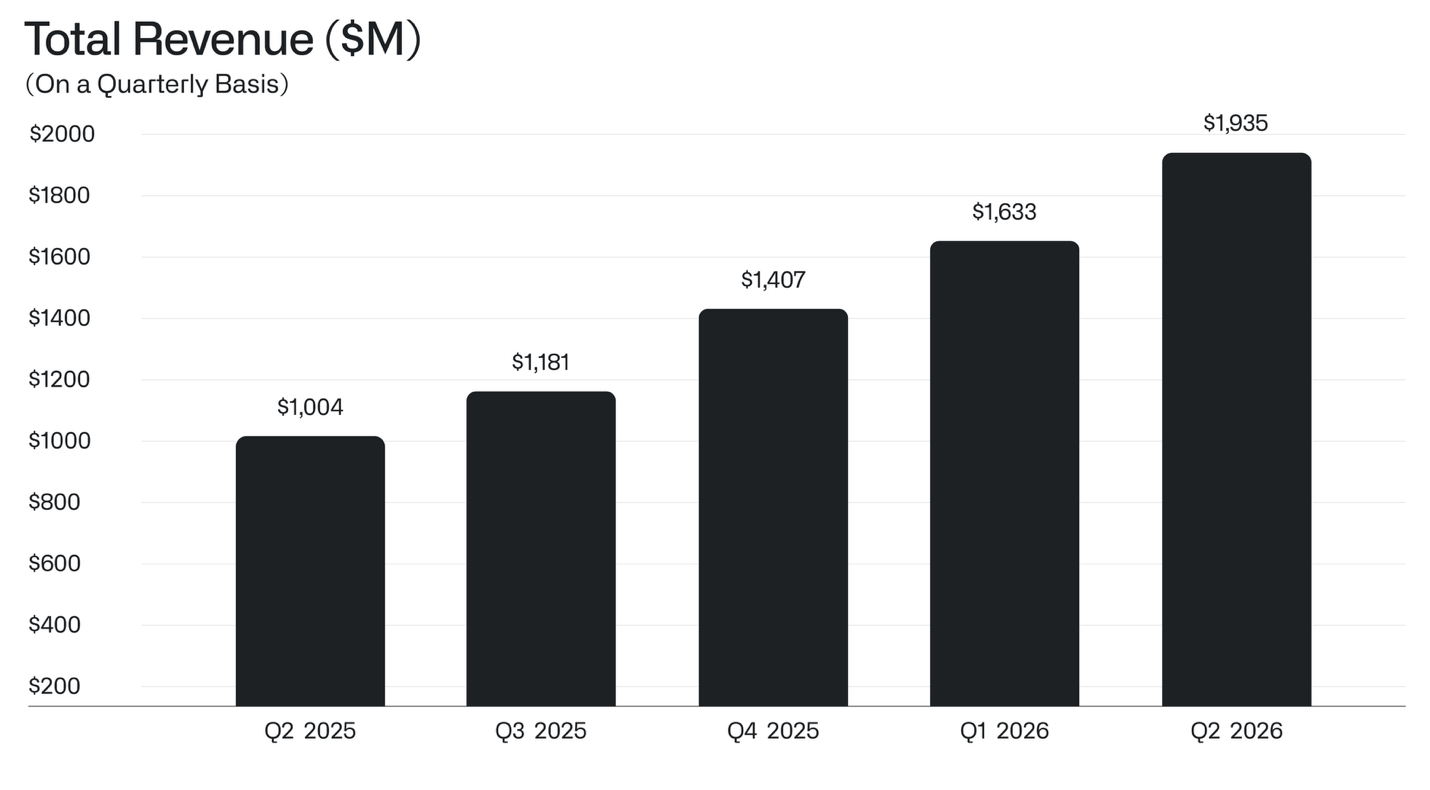
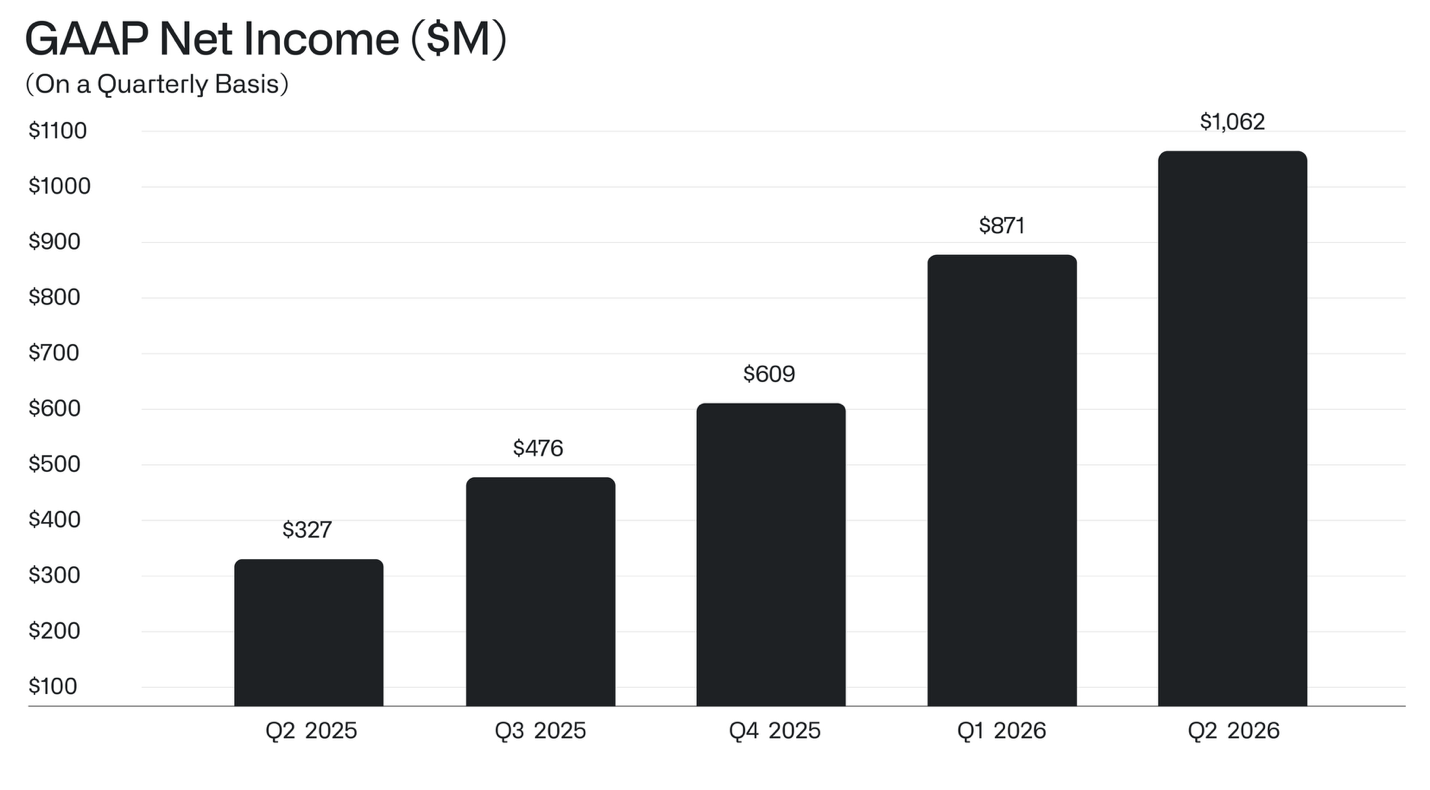
“And our record revenue has been accompanied by yet another record in quarterly profits. We generated $1.1 billion in profit in the second quarter of the year — an astonishing level of proceeds that for many on the outside, and even to some internally, would have been unthinkable only a few years ago.
Put simply, we have now generated more profit in a single quarter than we did in total revenue in the same period the year before.
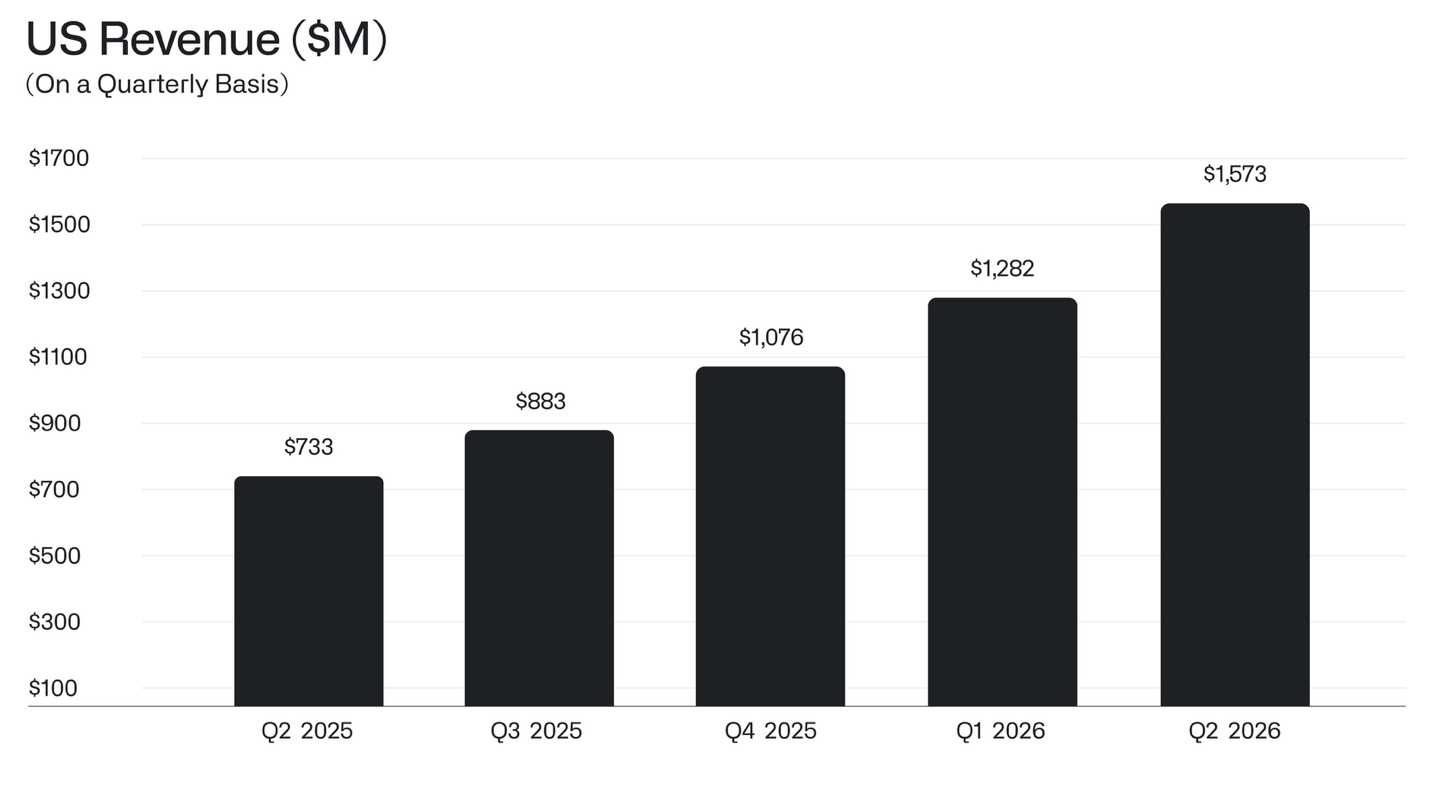
“And the core of our business, in the United States, continues to expand at an unrelenting and breakneck pace. We generated a record $1.6 billion in revenue for the second quarter in the United States, representing a 115% increase over the same period last year.
“We generated a record $764 million in U.S. commercial revenue this quarter — a 149% year-over-year increase. Such an achievement would be cause for astonishment in any business; for one of our size, scale, and consequence, it is simply staggering.
“On a quarter-by-quarter basis, our U.S. commercial business grew 28%. Such growth — indeed, such acceleration — gives the impression that what others might require a year or even longer to achieve, we can do in 90 days. And it must be noted that we have achieved these results with a minuscule and shrinking sales headcount, another way in which we have discarded conventional wisdom in favor of our own, unique path.
“While our U.S. commercial business is on fire, we believe it is nonetheless just nascent.”
3. “We are paid, and have always aspired to be paid, as a derivative of value creation.”
“The model of our business is straightforward. We are paid, and have always aspired to be paid, as a derivative of value creation. Our results represent a subset of the economic value that our software has created for our customers.
“We do not get paid for clicks or tokens or chats. The gamification of the most significant development in modern economic history seems to us misplaced. The usage of a platform may hint at its value but is by no means dispositive. And many are now finding out that consumption and usage alone often have little or nothing to do with the production of results.
“There are Marxist overtones and undertones to our business. Others, including many of those building large language models, intend, knowingly or otherwise, to capture the means of production of their purported partners. The limitations and faults of the token-industrial complex, which has threatened to overtake and dominate the world economy, have increasingly been exposed.
“We have always declined, and will continue to decline, entering into a parasitic relationship with our partners.
“It is true that our approach has diverged sharply from the market in this regard. And yet we are one of the few companies in the technology industry that is fully aligned with its customers.”
“Sincerely,
“Alex Karp, Co-Founder and Chief Executive Officer”
While Karp’s language is at times stinging — “We have always declined, and will continue to decline, entering into a parasitic relationship with our partners.” — his logic throughout is disarmingly simple:
- More and more, customers want total control over not only their data but also the value created from and around it. And as a fast-growing number of customers begin to comprehend more clearly that to date the beneficiaries have been the model companies rather than the customers whose efforts created that data and its proximate context, they will unconditionally join the “global movement” Karp is loudly championing.
- Beyond Karp’s riveting rhetoric, Palantir’s financial results continue to be astonishing and thereby lend enormous credibility to his views of what’s happening among customers (or as he says, “partners”).
- In the software industry’s earlier and simpler times, everybody offered price lists (well, not Palantir) because customers were buying products rather than investing in outcomes. Palantir’s runaway success could well inspire customers to push hard — very hard —on all of their software vendors to adopt similar types of value exchanges.
Final Thought
While big talk can sometimes be interesting and occasionally compelling, it’s often, behind all the fancy flourishes, both shallow and hollow. But when big talk is paired with big results — in Palantir’s case, extraordinary results — then only a blockhead would not be willing to at least consider what’s being said.