

Four hundred years ago, the English writer John Donne expressed a thought has begun to hit home for chief executives: “Never send to know for whom the bell tolls; it tolls for thee.”
While the AI Revolution has already eliminated hundreds of thousands of relavitely low-level jobs, the sheer scale of this unprecedented upheaval has also begun to take down CEOs who don’t understand AI’s massive implications, feel they’re not up to the challenge, or are too lazy to figure it out.
The Self-Aware CEO
Take former Walmart CEO Doug McMillon, who stepped down earlier this year after an 11-year tenure as CEO of the world’s largest retailer that was marked by widespread innovation, growth, and financial success including the following:
- Walmart’s market cap grew by more than $700 billion, topping $1 trillion earlier this year;
- annual revenue grew from $473 billion to $674 billion; and
- e-commerce revenue soared to $121 billion in Walmart’s latest fiscal year, up 12X from $10 billion when McMillon became CEO in 2014.
Over those 11 years, McMillon sagely steered Walmart through a range of challenges from Covid-19 to supply-chain turbulence to intense pressure from e-commerce-only companies. And when he stepped down, he was only 59 years old and in possession of an impeccable track record of fusing new technologies into one of the world’s largest corporations.
But as McMillon came to understand that the near future would be all about AI, he decided that the company that had employeed him since he was a teenager would need a new and “faster” leader for the AI Economy.
“With what’s happening with AI, I could start this next big set of transformations with AI, but I couldn’t finish,” McMillon told CNBC.
I’ve followed the business world and have studied CEOs for a very long time, and I can’t recall any other CEO — particularly one as young and as accomplished as McMillon — making a decision like that.
Community Summit North America
The largest independent innovation, education, and training event for Microsoft business applications delivered by Expert Users, Microsoft Leaders, MVPs, and Partners.
Register
The Lazy/Scapegoating CEO
At Salesforce’s Slackbot launch a few weeks ago, Marc Benioff participated in a fireside chat with Matthew Berman and made a harsh but true observation about CEOs who are unwilling to dig in deep and take full responsibility for the widespread upheaval AI will certainly cause.
Describing a range of reasons behind AI-involved layoffs, Benioff said, “These are different reasons, so you cannot bucket all these companies together. If you do, you’re making a fundamental mistake, I think, in business.”
“And even though I’ve spoken about this somewhat aggressively, I don’t think most people still really understand what is going on, and it’s too easy to kind of basically take AI and make it the scapegoat,” Benioff said.
“I think for some CEOs, it’s a lazy way out — and that’s on them. I think it’s better just to say ‘Here’s what’s really going on’ and try to be as specific as you can. You’re going to take bullets no matter what because that’s your role as CEO, and then you have to kind of go forward and put everything back together.”
Yes, it’s easy and probably very tempting to blame every tough decision and outcome on the nameless, faceless, and obscure villain AI (hey — the word “villain” even has “ai” embedded right in it!), but it’s also a sure sign of a CEO who’s in way, way over his or her head.
The Race-to-Nowhere CEO
I saw this graphic yesterday morning on LinkedIn and it summarizes this third category pretty darn well:
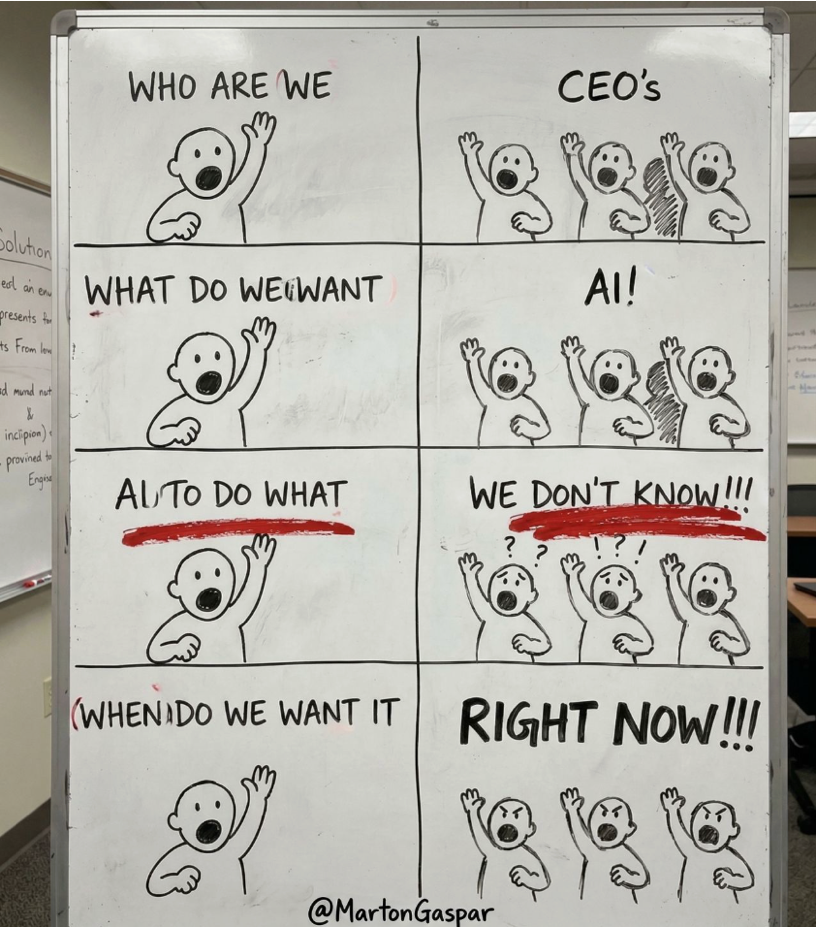
This variation comes in a couple of forms: lots of tactical activity everywhere with absolutely no strategic vision for scaling and internalizing all that effort; and creating lots of committees to study what competitors are doing and build feasibility studies with SWOT-ty titles and such but never advancing the company’s business objectives.
Final Thought
In the next 12 months, we’re going to see lots more examples of CEO turnover for each of the three reasons outlined above. If the AI Revolution can trigger the end for even great CEOs like Doug McMillon, imagine how rapidly it will expose the inadequacies and imperfections of average or mediocre CEOs for whom that infamous bell will surely be tolling.