


Pulling off the extraordinary feat of growing much faster even as it gets much larger, Palantir is also reframing customer expectations for AI by claiming that it has moved beyond software to “AI infrastructure” and that too many other tech vendors are pumping out ineffective “AI slop.”
That’s some brash talk from a company that’s by far the smallest on the Cloud Wars Top 10 and that’s flown well under the radar for most of its existence — and by the way, happy 23rd birthday today, Palantir!
But the astonishing Q1 financial results and future guidance that Palantir posted earlier this week give it massive credibility to speak publicly and loudly about its perceptions of what’s really going on among AI vendors and more importantly among customers betting their futures on AI technologies.
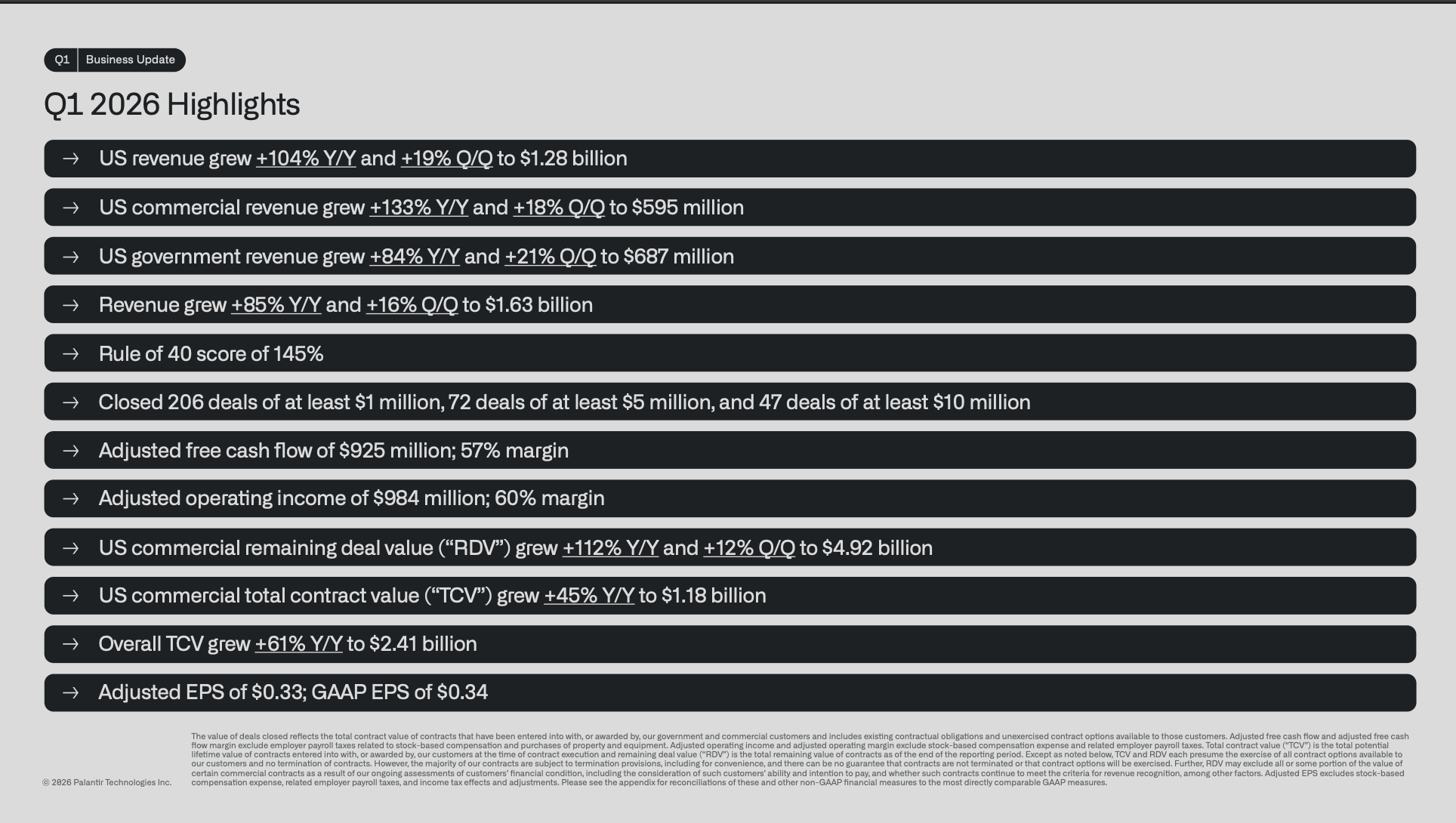
Let me first offer a quick recap of those breathtaking numbers, and then we’ll dig into the repercussions of the new terminology and categories Palantir is jamming into the public consciousness. The slides below from the Palantir Q1 2026 Business Update presentation tell a story of remarkably outsized growth even within the highly competitive context of the greatest growth market the world has ever known:


But of all the eye-popping numbers disclosed by Palantir, the one that I found to be most other-worldly was the number of salespeople the company deploys to drive those results: 70. No, that’s not a typo — and here’s CEO Alexander Karp to explain a bit more:
Big industrial companies “buy our product despite the fact we have 70 salespeople. A normal company of our size would have 7,000,” Karp said on the Q1 earnings call.
“Only seven of our salespeople actually even really sell. We are doing what a normal company would do with 7,000 salespeople with seven people. We are doubling the U.S., and we are dominating on the battlefield,” Karp said. “The reality that we will be able to drive 100% growth in the U.S. is being driven by the fact that our customers either know or will know that you need actual results. Those results require granularity, specificity, actual relationship to facts. The appearance of software working is not software working.”
The Rise of — And Threat Within — “AI slop”
One of the arguments made by Palantir that I find most compelling is that while it’s nice to use AI to boost efficiency and productivity, the true value lies in deploying AI to do things that were never before possible. And during the Q1 earnings call, Palantir executives used the term “AI slop” 17 different times to underscore that not all AI offerings are equal.
In this excerpt from the May 4 earnings call, CTO Shyam Sankar contrasts the business precision and potential that Palantir promises with the incomplete AI solutions that he says too many tech vendors are offering.
“A major telco set out to automate 10 million customer calls a year. The real insight was that the most dissatisfied customers never call; they churn silently,” Sankar explained. “The reframe was counterintuitive: do not use AI to reduce calls — use it to generate them with an AI advocate that proactively calls on every customer’s behalf. The point is simple: Use AI to do more work—work that was never economically feasible before AIP [AI Platform].”
Sankar went on to describe the precision that Palantir says differentiates its AI technologies from most other options. If other AI vendors can match this, then I would urge them to start clearly and plainly articulating those capabilities in the manner that Sankar offers here.
“For every agent action, our customers need to answer three questions: Who authorized this? What did it cost? Can I trust what it did? These questions need exact answers with precision–there is no tolerance for slop. We are building a platform-native agent engine SDK, a single set of primitives for building, persisting, governing, and operating ontology-native agents. A common layer that lets you visualize every agent in your enterprise and control it, regardless of how it was built. A true agent operating system.
“On top of that, unified cost attribution per agent, per session, per workflow, with administrative caps. Full provenance, so every ontology mutation traces back to the agent and reasoning chain that produced it. Security-marking propagation from input data through agent sessions onto all output, with approval gates for any workflow that could reclassify information. That is how you get a CISO, a CFO, and a combat commander to say yes.
“AIP is the no-slop zone — the platform where every agent action is governed, attributed, and auditable.”
CEO Karp: ‘Software’ Term Is Too Limiting
Palantir’s CEO has always been an outspoken leader. But as the company has exploded onto the global scene over the past couple of years, his blunt and visionary assessments of what the tech industry is doing and where it is headed have taken on greater significance and impact because —and the numbers reveal this unconditionally — customers are swarming to Palantir.
And as for whether what Palantir creates should be called “software” or the new term proposed by Karp, I can understand why some people might shrug their shoulders dismissively and say “who cares?”. But I think that misses the larger point: customers are buying what Palantir is creating in outsized proportions, and perhaps that means that vendors and customers should think long and hard about why “software” might no longer be the right way to talk about what AI does — and more important, what it can do.
“Now, I do think we are going to end up with a different term for software — you cannot just lump what we’re doing into ‘software’,” Karp said on the earnings call.
“We are really providing infrastructure and also the installation of AI infrastructure. If your [tech] company is largely running around and offering steak dinners with something that someone can hack and rebuild in a week, yes, you are going to have a huge problem. Business models that do not make sense are under huge pressure.
“And that is one of the reasons we are at the forefront — can you believe we are at the forefront of almost every discussion in the world? And it is simply because we are powering almost everything that works. Not everything—there are some other great companies out there. Many of them are not well known, and we should help publicize them—but we are at the forefront,” Karp said.
“And that is what these numbers show. You do not have to believe us.
“Believe your non-lying eyes.”