


Rather than replacing SaaS, AI is becoming its most powerful accelerator. Oracle’s approach embeds agentic AI across Fusion applications, enabling faster deployments, reduced operational complexity, and dramatically improved customer outcomes.
Rather than replacing SaaS, AI is becoming its most powerful accelerator. Oracle’s approach embeds agentic AI across Fusion applications, enabling faster deployments, reduced operational complexity, and dramatically improved customer outcomes.

Facing unprecedented pressure from customers navigating AI transformation, SAP, Oracle, and Workday are restructuring their sales organizations. Each company is simplifying customer engagement, flattening leadership structures, and aligning sales with services to deliver faster decisions and stronger outcomes.
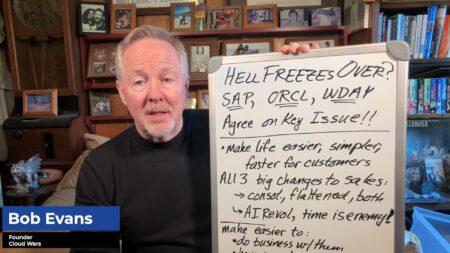
In a rare alignment, SAP, Oracle, and Workday are simplifying sales models to reduce complexity and accelerate digital transformation for customers navigating the AI revolution.
Rejecting “SaaSpocalypse” fears, Aneel Bhusri argues AI will enhance enterprise applications rather than replace them. Workday’s strategy focuses on AI agents embedded within its HR and finance platform to drive new growth and customer value.
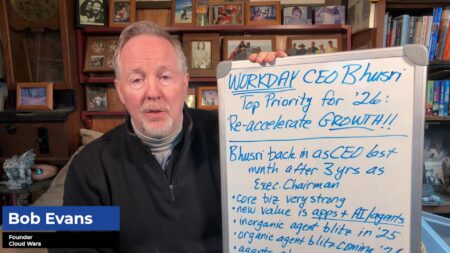
Workday is betting its future growth on blending AI agents with its existing HR and finance platforms, rejecting the notion that large language models alone can replace enterprise software.
Returning CEO Aneel Bhusri used Workday’s Q4 earnings call to dismantle claims that AI will replace ERP and HR systems, outlining instead a hybrid future where deterministic enterprise apps and probabilistic AI work together.
Workday cofounder Aneel Bhusri has returned as CEO following Carl Eschenbach’s departure, vowing to lead the company through what he calls its “most pivotal moment” as AI reshapes enterprise software and competitive dynamics.
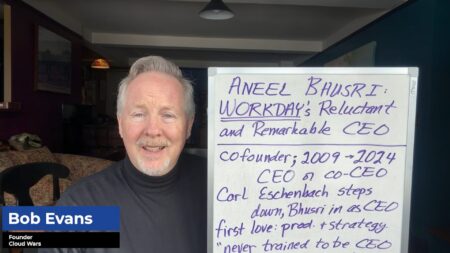
Amid leadership change and fierce competition, Aneel Bhusri’s return underscores Workday’s need for product-centric vision during a defining shift toward AI-powered enterprise software.

SAP outperformed competitors like Oracle and Salesforce, growing its cloud business by 200% more than some rivals.

According to Workday’s AI study, only 14% of companies consistently get clear results from AI. Investing in people, not just tech, is what truly drives long-term value and productivity.
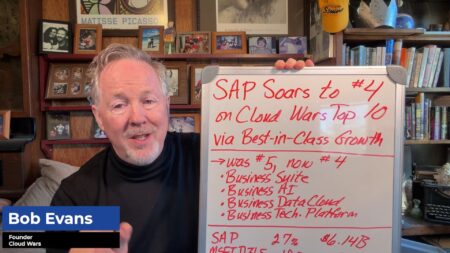
SAP’s cloud-first pivot delivers record performance, with growth nearly double that of Workday and triple that of Salesforce.

AWS tumbles to #7 as SAP climbs and Palantir rockets up the Cloud Wars rankings, reflecting shifting dynamics in the enterprise AI race.
Major shifts at the top of cloud rankings reflect customer focus, ecosystem strength, and future readiness rather than raw financial performance.

Palantir, Oracle, and Google Cloud dominate the Cloud Wars Growth Chart amid the AI Economy boom.
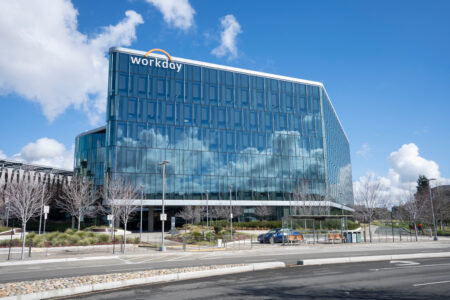
Strategic federal wins and healthcare momentum underscore Workday’s strong Q3, with AI adoption driving customer expansions and renewed 10-year commitments.

Workday completes acquisition of Sana announcing the combined technolgies as “the new front door for work.”

Workday introduced a new AI model library that brings domain-specific automation and deeper intelligence to enterprise contract management.

Despite Oracle’s AI infrastructure play, SAP stays the course with a strong software-first AI strategy, avoiding multibillion-dollar CapEx.

SAP is pulling far ahead of its rivals as the enterprise-apps market shifts toward agentic AI, posting growth rates more than double those of Oracle and Salesforce.
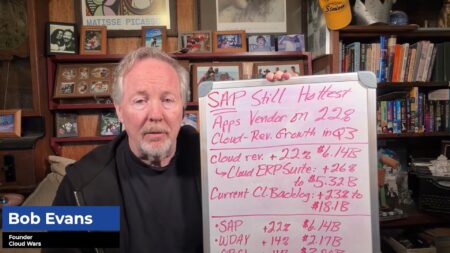
SAP’s focus on evolving its cloud ERP and Business Data Cloud platforms is paying off with dramatic Q3 gains.