

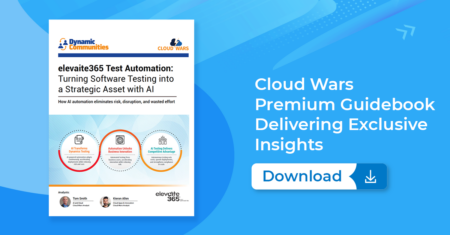
A practical guide to how AI-powered test automation eliminates the cost, risk, and disruption of manual software testing for Microsoft Dynamics 365 users.
A practical guide to how AI-powered test automation eliminates the cost, risk, and disruption of manual software testing for Microsoft Dynamics 365 users.

With only about 15% of consumers using customer-facing AI, grocery retailers are shifting their strategy. Instead of pushing AI directly to shoppers, companies are investing in AI copilots for store associates to drive operational efficiency and better customer service.
Salesforce’s planned acquisition of Momentum strengthens its AI portfolio by integrating unstructured conversational data into Agentforce 360 and Slackbot, accelerating agentic workflows and delivering deeper customer insights for sales and go-to-market teams.
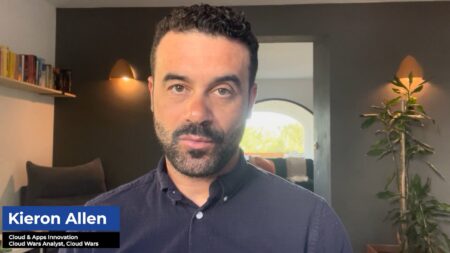
Microsoft expands Copilot with business-process agents, tuning templates, and standalone AI assistants designed to transform workflows across sales, finance, service, and enterprise productivity.
Salesforce delivered $41.5B in annual revenue and $11.2B in Q4, with Marc Benioff calling it one of the best performances in software history as AI offerings like Agentforce drive renewed growth momentum.

Salesforce posts 12% Q4 revenue growth and 14% RPO growth, signaling a confident return to high-performance execution.
Returning CEO Aneel Bhusri used Workday’s Q4 earnings call to dismantle claims that AI will replace ERP and HR systems, outlining instead a hybrid future where deterministic enterprise apps and probabilistic AI work together.
The company’s first Autonomous Workforce deliverable is a Level 1 Service Desk AI Specialist that diagnoses and resolves common, low-priority IT support requests.
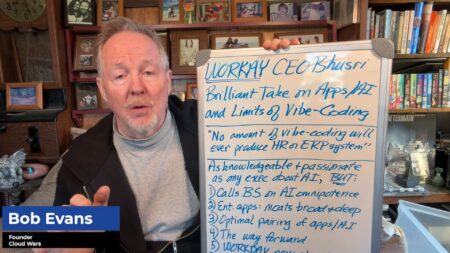
Workday’s Q4 call reframed the AI debate, emphasizing that enterprise applications remain essential even as AI accelerates innovation across HR, ERP, and beyond.
Mustafa Suleyman predicts AI will achieve human-level performance across most professional tasks within 18 months, signaling massive disruption — and opportunity — for white-collar workers.

The label “legacy” no longer fits Oracle, Microsoft, or SAP, each surpassing 50% cloud revenue. Their rapid cloud growth and AI investments demonstrate that experience, scale, and deep enterprise relationships are powerful assets in today’s AI Era.
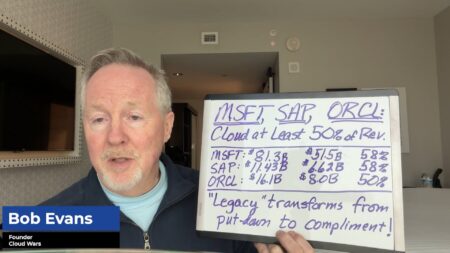
Legacy expertise in on-prem and cloud is emerging as a decisive advantage for Microsoft, SAP, and Oracle in the expanding AI economy.

Unilever and Google Cloud are building an AI-first marketing and fulfillment engine that signals a new era of agentic commerce.

Oracle’s new AI agents automate supply chain tasks including planning cycles, sourcing, inventory management, and logistics coordination, helping organizations improve resilience, efficiency, and operational visibility.

Scaling AI agents in 2026 requires autonomy, orchestration, and strong governance — not just building more bots.

AWS is seeing stronger-than-expected growth in non-AI workloads as enterprises accelerate cloud migrations. Jassy says both core infrastructure and AI services are driving demand, requiring rapid capacity expansion across data centers and power infrastructure.
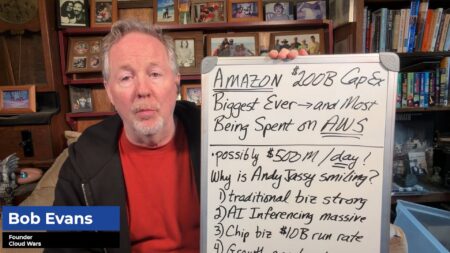
With $500 million per day flowing into AWS, Amazon is making the largest infrastructure bet in corporate history to dominate the AI-driven cloud era.

ServiceNow CEO Bill McDermott says AI is “devouring” low-value software vendors as enterprises demand AI embedded directly into workflows. He insists ServiceNow is not SaaS but a platform company positioned to lead the Agentic AI Era.

From natural language assistance to intelligent workflow orchestration, this collaboration signals a major shift toward agentic AI in the enterprise.
Workday cofounder Aneel Bhusri has returned as CEO following Carl Eschenbach’s departure, vowing to lead the company through what he calls its “most pivotal moment” as AI reshapes enterprise software and competitive dynamics.