


AWS tumbles to #7 as SAP climbs and Palantir rockets up the Cloud Wars rankings, reflecting shifting dynamics in the enterprise AI race.
AWS tumbles to #7 as SAP climbs and Palantir rockets up the Cloud Wars rankings, reflecting shifting dynamics in the enterprise AI race.
The Cloud Wars Top 10 has been reshaped by AI momentum, customer demand, and a new definition of cloud leadership.
Major shifts at the top of cloud rankings reflect customer focus, ecosystem strength, and future readiness rather than raw financial performance.

Palo Alto Networks’ Prisma AIRS and Google Cloud AI unify to ensure security from development to deployment.

Christian Klein’s long-term focus on sovereignty has shaped a cloud strategy that avoids pitfalls of hyperscaler competition and promotes EU autonomy.

BNY Mellon deploys Gemini-powered Eliza AI across its organization, turning cultural change into a competitive advantage in the age of AI.

AWS is investing $50 billion to expand AI and supercomputing infrastructure for U.S. government agencies, accelerating cloud innovation.

Leaders unpack why later-generation cloud platforms, bare-metal architectures, and multi-cloud strategies can cut costs by up to 70% and fuel enterprise AI adoption.

Google Cloud CTO Will Grannis urges enterprises to reverse-engineer AI strategies around customer needs, not technology, for deeper transformation.

Google Cloud’s CTO explains how Gemini-powered, agentic AI is transforming business workflows, culture, and customer experiences across industries.

enVista’s Nathan Bensch outlines how the AI Agent & Copilot Summit is shifting from Copilot basics to full-scale AI agents with practical, technical, and strategic content.
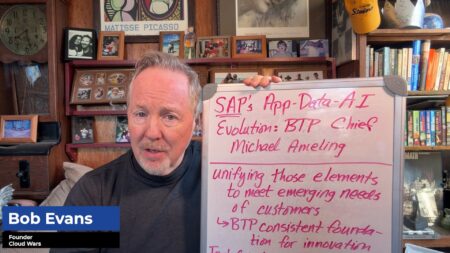
SAP is aligning Business Data Cloud, Joule, and partner ecosystems to create an integrated foundation for enterprise AI.

Google Cloud under Kurian’s leadership has become a dominant force in enterprise AI with the seamless, end-to-end Gemini Enterprise platform.

Palantir surges to the top of the Cloud Wars Growth Chart with 63% growth.

Oracle’s AI Data Platform empowers organizations to drive AI transformation by unifying and leveraging their business data, enabling industry-specific intelligence and automation across Oracle’s extensive application ecosystem.

Mahesh Thiagarajan, Executive Vice President of Oracle Cloud Infrastructure (OCI), discusses Oracle’s vision for fulfilling customer expectations and ambitions in the AI Era.
In this interview, Palantir’s Chad Wahlquist articulates how their AI platform (AIP) is not just another product but an operating system for enterprise business, enabling global optimization across supply chain, inventory, demand, rather than local point solutions.

Oracle’s strategy, as outlined by Loaiza, is designed to meet customers wherever they operate — whether on-premises, in the public cloud, across multicloud hyperscaler environments, or within a fully deployed cloud region located directly in a customer’s data center.

Oracle is using its multicloud partnerships with Microsoft, Google and AWS to reignite its core database business. It aims to reach $20 billion in revenue within five years by riding the AI inference wave and offering flexible multicloud deployment.

The Microsoft‑Oracle database partnership is generating nearly all of Oracle’s multi‑cloud database growth so far, with Larry Ellison believing AWS and Google Cloud will ramp up soon and drive the next wave of revenue.