


Explosive enterprise demand for AI and cloud services is driving a resurgence of hypergrowth across the Cloud Wars Top 10, led by Palantir, Google Cloud, and Oracle.
Explosive enterprise demand for AI and cloud services is driving a resurgence of hypergrowth across the Cloud Wars Top 10, led by Palantir, Google Cloud, and Oracle.

Rather than replacing SaaS, AI is becoming its most powerful accelerator. Oracle’s approach embeds agentic AI across Fusion applications, enabling faster deployments, reduced operational complexity, and dramatically improved customer outcomes.
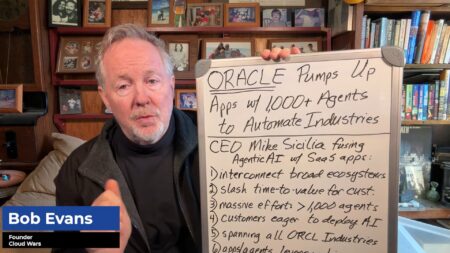
Oracle is rejecting the “end of SaaS” narrative, arguing that AI agents will dramatically expand the power and value of enterprise applications.

Mason Siefert explores the concept of smart friction in the grocery industry, which enhances brand identity and customer experience.

Andrea Pinillos shares how Microsoft helps enterprise customers run strategic engagement events through internal tools and explains how similar practical solutions can help organizations deploy AI agents that connect to real business data.
Organizations must balance AI experimentation with governance to prevent shadow AI projects from fragmenting data and creating new security risks.

Microsoft’s new Copilot Tasks signals a shift from AI chat to autonomous action, positioning Copilot as a personal assistant that can manage everyday tasks through natural-language commands.

New AI features deliver notable enhancements to five types of SharePoint content while the UX is refreshed and agentic AI strengthens governance.

Anthropic Claude-powered feature headlines Copilot Wave 3 announcement. Other enhancements include app-native Copilots and the Microsoft 365 E7 ‘Frontier Suite.’

In this episode, Diego Araujo discusses the challenges enterprises face when adopting AI copilots in Dynamics 365 Finance & Operations, emphasizing governance, user adoption, and selecting high-impact use cases that can demonstrate value quickly and overcome skepticism.

ServiceNow introduces the Autonomous Workforce — AI specialists that work alongside humans to run enterprise workflows end-to-end.

Facing unprecedented pressure from customers navigating AI transformation, SAP, Oracle, and Workday are restructuring their sales organizations. Each company is simplifying customer engagement, flattening leadership structures, and aligning sales with services to deliver faster decisions and stronger outcomes.

OpenAI has secured $110 billion in funding from Amazon, NVIDIA, and SoftBank, valuing the company at $730 billion. The investment aims to expand global AI infrastructure, accelerate frontier model development, and scale enterprise and consumer AI adoption worldwide.

As enterprises require AI models to deliver consistent, secure performances on a regular basis, organizations need an AI-ready security foundation that protects their data, meets regulatory demands, and brings order.
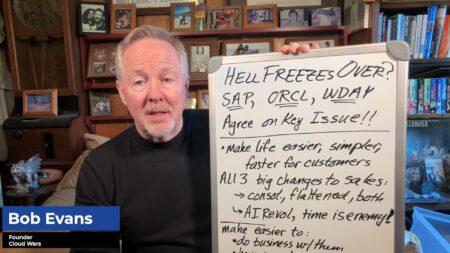
In a rare alignment, SAP, Oracle, and Workday are simplifying sales models to reduce complexity and accelerate digital transformation for customers navigating the AI revolution.

Oracle’s fiscal Q3 could deliver massive cloud and RPO growth driven by AI demand, though it may still fall short of Google Cloud’s 48% hyperscaler growth benchmark.
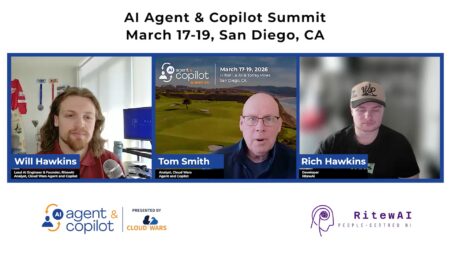
Framework lets users and developers bring their own models, supports both A2A and MCP for seamless integration of diverse AI tools, Will Hawkins and Rich Hawkins note.

With only about 15% of consumers using customer-facing AI, grocery retailers are shifting their strategy. Instead of pushing AI directly to shoppers, companies are investing in AI copilots for store associates to drive operational efficiency and better customer service.
Rejecting “SaaSpocalypse” fears, Aneel Bhusri argues AI will enhance enterprise applications rather than replace them. Workday’s strategy focuses on AI agents embedded within its HR and finance platform to drive new growth and customer value.

Monday’s outage impacting several Claude tools was relatively brief, but it highlights the integral role of AI in modern workflows and the need for robust continuity plans.