


Deloitte partner says most organizations are still in the transition phase of tapping AI in their ERP environments, but the technology can improve data consistency and improve financial compliance.

“You give us three minutes and we will give you unique insights on the greatest growth market the world has ever known!“

I am your host, Bob Evans. Here you will see a full library of our daily news and commentary show from Cloud Wars that shares insights and perspective around the “re-imagination machine” that is the Cloud!
Deloitte partner says most organizations are still in the transition phase of tapping AI in their ERP environments, but the technology can improve data consistency and improve financial compliance.
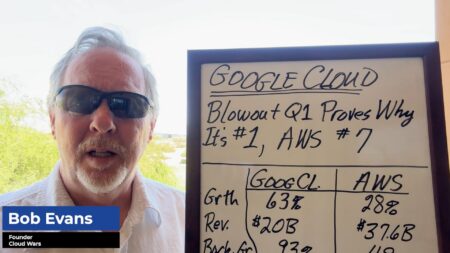
Google Cloud’s explosive Q1 growth and backlog dominance highlight a major shift in cloud leadership, overtaking AWS as AI-driven demand reshapes competitive dynamics among hyperscalers.

Definity First founder Mauricio Duran explains why enterprises must start with business problems — not technology — to successfully move AI into production.

At the AI Agent & Copilot Summit, Truvio’s Jorgen Bach explains how unified platforms and AI agents are helping enterprises close the ERP value gap and operationalize AI adoption.

Oracle argues the future is not apps versus agents, but applications and agents working together as one.

Addition to Microsoft 365 Copilot helps users sort through large amounts of data and conversations to determine required near-term actions and build comprehensive plans.

Dona Sarkar explains why AI should be viewed as a tool for empowerment rather than job replacement, urging professionals to become “AI power users” who learn how to harness AI within their own roles and industries.

Stellantis and Microsoft launch a sweeping AI partnership spanning engineering, cybersecurity, and enterprise transformation.

Google Cloud’s $750M ecosystem investment and major AI push signal an aggressive move to lead the agentic AI transformation race among hyperscalers.

While many predict AI will destroy enterprise software vendors, SAP’s Q1 2026 results tell a different story: cloud revenue rose 27%, Cloud ERP Suite grew 30%, and backlog climbed 25%, proving strong momentum.

A major focus for sa.global is building industry-specific AI agents tailored to professional services sectors like construction and legal, aiming to reduce inefficiencies, automate workflows, and protect revenue streams.
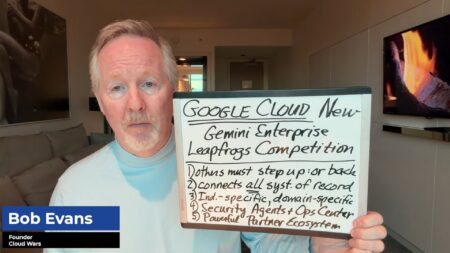
At Google Cloud Next, Gemini Enterprise emerges as a major step forward in enterprise AI, combining integrated data access, industry agents, advanced security, and partner innovation into a simplified, end-to-end platform.
By leveraging AWS Interconnect multicloud, Oracle enhances its cloud offerings with private, high-speed connections that simplify multi-cloud deployments and unlock new opportunities for enterprise agility and performance.

Tad Remington explains how Solver is embedding AI agents into FP&A workflows, enabling organizations to analyze trusted, pre-structured financial data and streamline planning processes without requiring extensive manual intervention or custom-built systems.

Google Cloud heads into Next with momentum, expected to unveil major advances in AI security, sovereignty, and Gemini Enterprise to strengthen its leadership in the rapidly evolving AI Economy.

Multi-cloud partnerships reveal a deeper divide in cloud leadership, where Oracle’s early moves enabled seamless cross-platform deployment, leaving AWS positioned as a delayed follower.

Microsoft addresses the limitations of pure AI autonomy by integrating workflows and agents, creating more structured, flexible automation systems tailored to enterprise production environments.

AI disruption is shifting from workforce layoffs to CEO accountability, as companies demand faster, decisive leadership to survive the transformation reshaping every industry.
AI agents are advancing rapidly, but compliance concerns persist, and Panopticore aims to solve this with deterministic governance and verifiable audit trails at the network infrastructure level.

Despite Microsoft and AWS dominating in scale, Google Cloud’s Q4 performance suggests it may be capturing a disproportionate share of new enterprise cloud and AI workloads.