


Rather than replacing SaaS, AI is becoming its most powerful accelerator. Oracle’s approach embeds agentic AI across Fusion applications, enabling faster deployments, reduced operational complexity, and dramatically improved customer outcomes.
Rather than replacing SaaS, AI is becoming its most powerful accelerator. Oracle’s approach embeds agentic AI across Fusion applications, enabling faster deployments, reduced operational complexity, and dramatically improved customer outcomes.
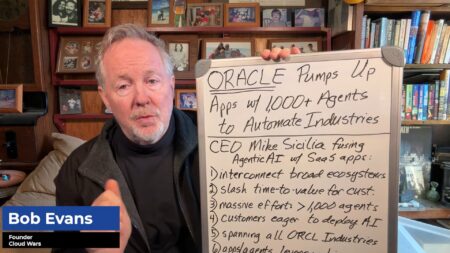
Oracle is rejecting the “end of SaaS” narrative, arguing that AI agents will dramatically expand the power and value of enterprise applications.

Oracle posted explosive Q3 results fueled by unprecedented demand for AI infrastructure. The company’s cloud business grew rapidly, while its data-center expansion strategy and financing plans attracted strong investor support and reinforced confidence in its long-term AI strategy.

Facing unprecedented pressure from customers navigating AI transformation, SAP, Oracle, and Workday are restructuring their sales organizations. Each company is simplifying customer engagement, flattening leadership structures, and aligning sales with services to deliver faster decisions and stronger outcomes.
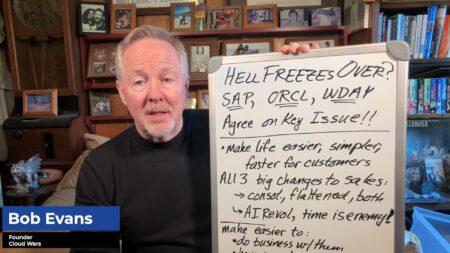
In a rare alignment, SAP, Oracle, and Workday are simplifying sales models to reduce complexity and accelerate digital transformation for customers navigating the AI revolution.
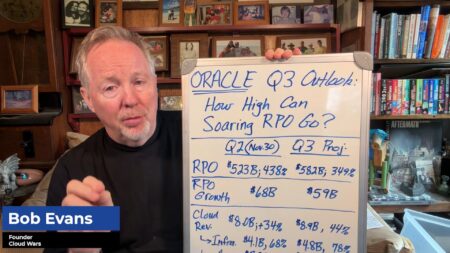
Oracle’s Q3 outlook reveals explosive growth in remaining performance obligations, suggesting the company’s AI training and infrastructure capabilities are driving enormous future demand beyond its OpenAI partnership.

Unilever and Google Cloud are building an AI-first marketing and fulfillment engine that signals a new era of agentic commerce.

By combining AWS AI capabilities with NTT DATA’s delivery scale, the partnership accelerates legacy modernization and responsible AI adoption in highly regulated sectors worldwide.

Google Cloud and AWS surpassed Microsoft in Q4 cloud revenue growth, signaling a shift in customer preference and prompting a downgrade of Microsoft to #3 in the Cloud Wars Top 10.

Despite a record-setting $35.6B quarter, AWS slid to #7 in the Cloud Wars as Google, Oracle, and Microsoft gained ground.

With a 48% Q4 surge, Google Cloud has overtaken Microsoft Cloud in incremental growth, demonstrating strong AI leadership via innovations like Gemini 3 and a future-ready cloud stack.

Google Cloud’s Q4 surge confirms its rise to #1 in Cloud Wars, outpacing Microsoft in growth, momentum, and future-focused AI strategy.

AWS announces general availability of its European Sovereign Cloud, expanding EU-only infrastructure while meeting strict data sovereignty requirements.

Once dismissed as outdated, Oracle, Microsoft, and SAP are now cloud and AI growth leaders, occupying top Cloud Wars ranks.

SAP’s surge to #4 in the Cloud Wars Top 10 reflects breakout growth, a reinvented cloud-first portfolio, and booming customer demand for apps, AI, data, and agents.
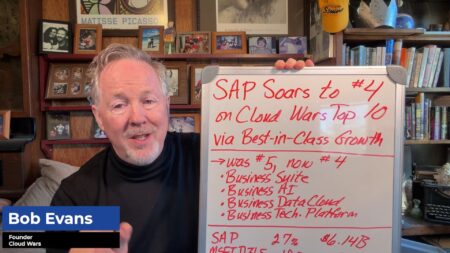
SAP’s cloud-first pivot delivers record performance, with growth nearly double that of Workday and triple that of Salesforce.

Despite record growth, Microsoft lost its #1 cloud ranking due to cybersecurity failures exposed by a federal watchdog report and internal leadership admissions.
AI reaches its full potential when insight, scale, verification, and execution converge into autonomous systems that deliver measurable real-world outcomes.
Mike Sicilia shares details on the culture and mindset that has boosted Oracle to the #2 spot on the Cloud Wars Top 10 rankings, as highlighted in this recap.

Oracle’s rise to #2 in the Cloud Wars Top 10 rankings is driven by AI innovation, cloud growth, and strong execution from leadership.